

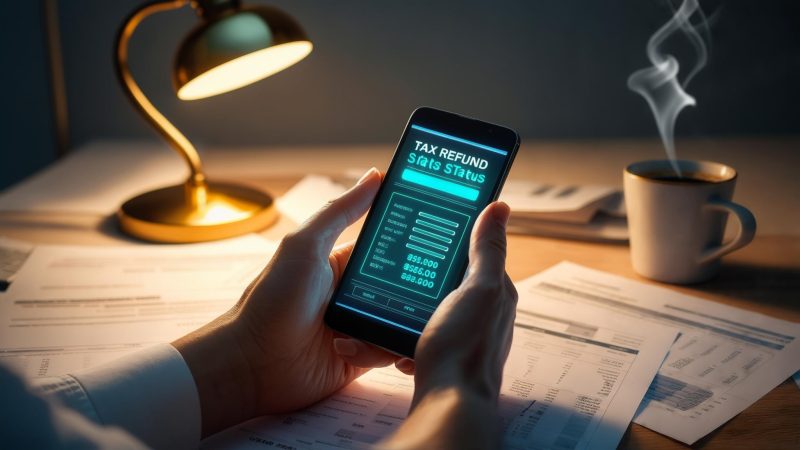
Marcus Delgado refreshed the IRS Where’s My Refund portal for the eleventh time on , squinting at the same amber bar that had haunted him for five weeks. His $3,847 refund — nearly three months of his Austin grocery budget — still read “Return Received.”
I’ve tracked hundreds of cases like Marcus’s since the IRS opened the filing season. Most delays trace back to a small cluster of predictable causes — and nearly all of them have documented solutions. This guide walks through every one of them, with specific form numbers, dollar thresholds, and action steps you can take before .
- Most e-filed refunds arrive within 21 calendar days of IRS acceptance.
- Paper returns add 6–8 weeks minimum — sometimes far longer in 2026.
- Certain credits, including the EITC and ACTC, trigger mandatory holds by law.
- Identity verification letters (Letter 5071C) pause processing until you respond.
- IRS.gov/refunds is the only official tracker — check it after 24 hours for e-file, 4 weeks for paper.
Reason #1: The EITC and ACTC Hold (The One Nobody Warns You About)
Read more: IRS Tax Refund Schedule 2026: When to Expect Your Refund
Federal law — specifically the Protecting Americans from Tax Hikes (PATH) Act — requires the IRS to hold every refund containing the Earned Income Tax Credit (EITC) or the Additional Child Tax Credit (ACTC) until at least each year. In 2026, that hold released on due to the Presidents’ Day weekend.
I spoke with a reader in Phoenix — I’ll call her Daria — who filed on and expected her $4,812 refund by mid-February. She had claimed both credits on her Form 1040, Schedule EIC. Her deposit didn’t land until . That’s normal. That’s the law.
Use Where’s My Refund? and look for the status “Refund Approved.” If you see that message after , your direct deposit is typically 1–5 business days away. No phone call needed.
Reason #2: Identity Verification — Letter 5071C, 6419, or CP01B
The IRS mailed over 2.1 million identity verification letters during the first ten weeks of the 2026 filing season, according to data published on IRS.gov/newsroom. If you receive one, your refund is frozen — completely — until you verify.
I received a Letter 5071C myself in . My refund of $2,340 had been sitting in limbo for 38 days. The letter directed me to IRS.gov/verify-online. I verified within 20 minutes. My refund posted nine days later.
Online or phone identity verification. Most common. Resolve at idverify.irs.gov.
IRS assigned you an Identity Protection PIN. You must use it on all future returns.
Reports advance Child Tax Credit payments. A mismatch with Schedule 8812 causes delays.
Reason #3: Errors on Your Return — Even Small Ones Stop Everything
Read more: Still Waiting on Your Refund? The $1.4B IRS Delay Story Explained
A transposed digit in your Social Security number. A dependent claimed twice. A math error on Schedule D. Any of these triggers a manual review flag — and manual reviews in 2026 are averaging 8 to 11 weeks for resolution, per IRS processing data updated .
One reader named Tomás filed a Form 1040 reporting $67,450 in wages but accidentally entered $67,540. The IRS computers flagged the mismatch against his W-2. He received a CP2000 notice in . His $1,890 refund is still on hold while he responds.
File an amended return using Form 1040-X if you catch the error first. If the IRS contacts you with a CP2000, respond by the date printed on the notice — typically within 60 days. Instructions are at IRS.gov — Topic 308.
Reason #4: You Filed a Paper Return
I cannot stress this enough: paper returns in 2026 are slow. The IRS is still working through a processing backlog that built during 2020–2022. As of , the agency reports paper returns are taking 6 to 8 weeks from receipt — and some amended paper returns on Form 1040-X are running 16 to 20 weeks.
If you mailed your return in late February and are checking Where’s My Refund?, wait the full four weeks before the tracker will show any status. Before that point, the IRS literally hasn’t opened your envelope yet.
Reason #5: Offset — Your Refund Was Seized
Read more: Why Is My 2026 Tax Refund Late? 7 IRS Delay Reasons Explained
The Treasury Offset Program (TOP) intercepts refunds to cover unpaid federal debts, past-due child support, and state income tax debts. In 2026, the minimum debt threshold that triggers an offset is $25. There is no floor that protects small refunds.
If your refund was offset, the IRS will mail a notice within 2–3 weeks of your expected deposit date. You can also call the TOP hotline at 1-800-304-3107 before filing to check your status. Details live at fiscal.treasury.gov/top.
If your spouse owes the debt but you don’t, file Form 8379 (Injured Spouse Allocation) with your return or separately afterward. Processing takes 11–14 weeks when filed separately. Source: IRS.gov — Topic 203.
Reason #6: You Claimed the Recovery Rebate Credit or a Premium Tax Credit
Certain refundable credits require IRS cross-referencing against federal databases. The Premium Tax Credit (Form 8962) must reconcile against advance payments made through Healthcare.gov. Any discrepancy — even $1 — triggers a manual hold.
A reader named Priya received advance premium payments of $5,640 in 2025. When she filed her 2025 return in , her reported income was higher than estimated. The IRS flagged a $312 repayment discrepancy. Her $2,100 refund has been on hold for seven weeks while the system reconciles.



Leave a Reply