
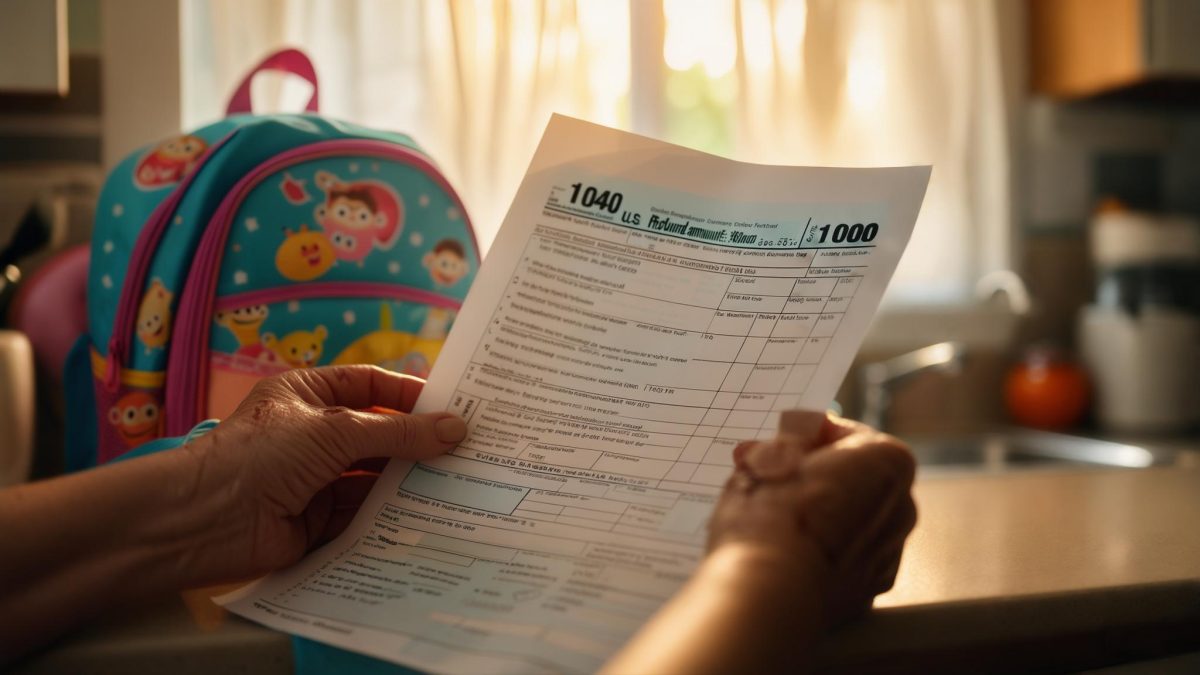
Most financial advice assumes you have a safety net. A partner, a parent, a savings cushion, something to absorb the gap between when money is owed and when money arrives. For a significant number of Americans — particularly single parents in high cost-of-living cities — that assumption is flatly wrong. The IRS refund timeline was not designed with them in mind, and the consequences of a delayed deposit aren’t abstract. They show up as a late fee, a skipped grocery run, or a quiet conversation with a daycare director about extending payment by one more week.
When I sat down with Samantha Reeves, 31, in late March 2026, she had just received her federal tax refund after a 49-day wait. She works as a registered nurse at a community hospital in Denver, Colorado. She is her daughter’s only financial provider. And for seven weeks this year, she watched a number on the IRS website that never seemed to move.
The Math That Makes Every Month a Calculation
Before I could understand why the refund delay hit so hard, Samantha walked me through her monthly budget. She earns approximately $72,000 annually in base salary, with overtime pushing some months higher. On paper, that sounds workable. Denver’s reality is different.
Her rent runs $1,650 per month for a two-bedroom apartment she shares with her five-year-old daughter, Lily. Daycare costs $1,400 per month — a figure she described to me with the resigned tone of someone who has stopped being shocked by it. Her student loan payment on a $38,000 balance adds another $290 monthly. After taxes, insurance premiums, and utilities, the margin is thin enough that a single unexpected expense can cascade.
Her ex-partner left two years ago and has been unreachable since. There is no child support order being enforced, no co-parent splitting pickup duties, no second income filling holes. “I stopped waiting for him to come back around,” Samantha told me. “You just have to build a life that doesn’t depend on a variable you can’t control.”
That philosophy is admirable, but it also means her tax refund is not a bonus. It is a structural part of how she covers the first quarter of the year, when overtime hours are lower at her hospital and the post-holiday bills are highest.
Filing Early, Waiting Longer Than Expected
Samantha filed electronically through a tax preparation software platform on February 4, 2026, selecting direct deposit to her checking account. She reported her W-2 income, claimed the Child Tax Credit for Lily, and also claimed the Earned Income Tax Credit — a credit specifically designed for low-to-moderate income working individuals that, according to the IRS, requires additional processing time due to identity verification requirements under the PATH Act.
That last detail matters. Under the Protecting Americans from Tax Hikes (PATH) Act, the IRS is legally prohibited from issuing refunds that include the EITC or the Additional Child Tax Credit before mid-February. In 2026, the IRS began releasing those refunds after February 15. Samantha had not fully understood that provision when she filed.
“I checked the ‘Where’s My Refund’ tool probably twice a day,” she told me. “Every morning before my shift. Sometimes on my lunch break. It just kept saying ‘processing’ and I didn’t know if that was normal or if something was wrong.”
Her return status moved from “Return Received” to “Return Being Processed” and then appeared to stall. She did not receive any written notice from the IRS indicating a problem. As Samantha explained, that silence was its own kind of stress — she couldn’t tell whether the delay was routine or whether her return had triggered a review.
The Week She Considered Calling the IRS Directly
By the end of February, Samantha had reached day 26 — past the IRS’s general 21-day benchmark for electronic filers. She had covered February’s daycare bill using a portion of her overtime from January. But March’s bill would be due in ten days, and her checking account was at $340 after rent cleared.
She looked up the IRS Taxpayer Assistance Center number and considered calling but ultimately decided against it after reading that hold times in February and March can run over two hours. She had a 12-hour shift the next morning. The call didn’t happen.
What she did instead was methodical. She picked up an extra overnight shift on March 1 — 12 hours at time-and-a-half — which put approximately $310 after taxes into her account. It was enough to cover the daycare gap without dipping into the small emergency fund she guards carefully. “I know nurses who’ve burned out doing exactly what I did that week,” she said. “I just didn’t have another option I was willing to take.”
When the Deposit Finally Appeared
On March 25, 2026 — day 49 — Samantha’s refund of $3,812 landed in her checking account. The “Where’s My Refund” tool had updated to “Refund Sent” two days prior, on March 23, consistent with the typical two-business-day lag between IRS transmission and bank posting that the IRS notes on its refund FAQ page.
The $3,812 was gone in under 48 hours — not wasted, but completely absorbed by existing obligations. “People think a refund is found money,” Samantha told me. “For me, it’s just money I already earned that the government held for a while. It goes straight to real things.”
She mentioned she had considered adjusting her W-4 withholding to increase her monthly take-home rather than receive a lump-sum refund — a commonly discussed approach. But she acknowledged she hadn’t followed through on it. “I know I should probably do something different,” she said. “But changing the withholding and then budgeting around a smaller refund requires mental energy I don’t always have at 7 PM after a 12-hour shift.”
What the 49-Day Wait Actually Reveals
Samantha’s case was not unusual. The IRS processed approximately 163 million individual returns in the 2024 filing season, and the agency has faced persistent staffing and backlog challenges documented by the Taxpayer Advocate Service. Returns claiming EITC are among the most common triggers for extended processing windows — by statute, not by error.
The gap between policy design and lived experience is where Samantha’s story sits. The PATH Act delay is a fraud-prevention measure. It is also, for sole providers counting on that money in February, a month-long hold on funds they have already earned. Those two things can both be true simultaneously.
When I asked Samantha what she would tell another single parent filing this year, she was quiet for a moment. “Don’t count on it being there in three weeks if you’re claiming the child credits,” she said. “Plan for it to take six or seven. If it comes faster, great. But build your February and March around it not being there.”
She paused, then added something I didn’t expect: “And if you can, find out what credits you’re leaving on the table. I had no idea about the Child and Dependent Care Credit until my coworker mentioned it this January. I might have been eligible for that for two years and didn’t claim it.” That credit, which covers a percentage of qualifying childcare expenses for working parents, is reported on Form 2441. Whether Samantha qualifies in a future year is a question for a tax professional — not something I can assess. But the fact that she didn’t know it existed for two years of solo parenting says something about the gap between available help and accessible information.
I left our conversation with a specific image in mind: Samantha checking a government website at 6:30 AM before a shift that will last until 7 PM, watching a status bar that doesn’t move, doing arithmetic in her head about daycare cutoff dates, and then walking into a hospital to care for other people’s families. The IRS’s processing timeline is a number on a chart somewhere. For her, it was the texture of seven weeks of her life.
Related: A Denver Nurse Paying $1,400 a Month for Daycare Didn’t Know She Qualified for a $2,000 Tax Credit
Related: He Avoided His Bank Statements for Two Years. Then Tax Season Forced Him to Look




Leave a Reply