

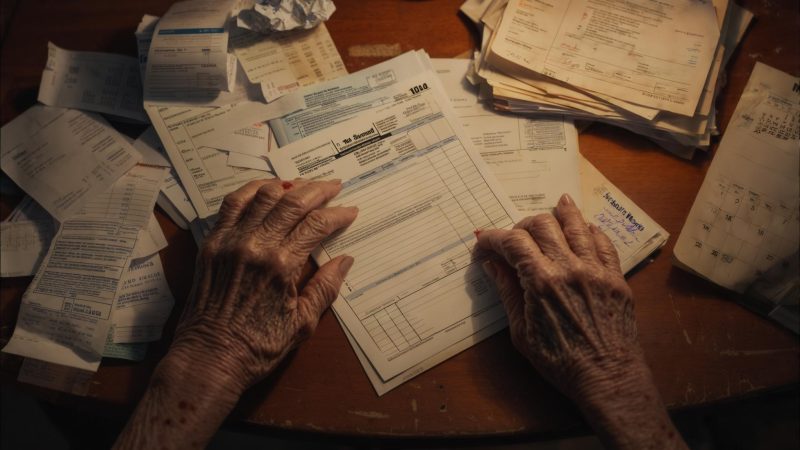
Have you ever built a month’s worth of decisions around a number that hasn’t arrived yet — a number the government technically owes you? I think about that question every time I sit across from someone whose financial life is organized around a refund that’s somewhere in a processing queue, neither confirmed nor denied.
It was a social worker named Dale Hutchins at the Jefferson County Assistance Office in Louisville who first suggested I speak with Bernice Yarbrough. “She’s been waiting on a refund since February,” he told me in late March. “And she’s not the type to complain, which is exactly why I’m telling you.” I reached out to Bernice that same afternoon. She agreed to meet me at a Panera two blocks from the factory where she works the 6 a.m. shift.
A Family Budget With No Slack in It
When I sat down with Bernice Yarbrough, the first thing she did was apologize for being five minutes late. She’d come straight from dropping her seven-year-old son, Marcus, at a specialized care program. Marcus has a developmental disability that requires full-time support, and the coordination involved in getting him there each morning is, as Bernice put it, “its own job before the real job starts.”
Bernice earns roughly $38,400 a year as a machine operator at a manufacturing facility in Louisville’s South End. Her husband, Terrell, works part-time — his hours were cut in late 2025 — bringing their combined household income to around $51,000. They bought their home in 2022, a three-bedroom in the Shawnee neighborhood, with a monthly mortgage payment of $1,490. At the time of purchase, that number was manageable. By early 2026, it represented a bruising 35 percent of their take-home pay.
Bernice and Terrell have no retirement savings. None. “We keep saying we’ll start next year,” she told me, folding her hands around her coffee cup. “But next year always has something in it.” This year, that something was Marcus’s new therapy program — $310 a month not covered by their insurance — and a water heater that died in November, costing $740 to replace.
Why She Was Counting on That Refund
Bernice filed her 2025 federal return on February 4, 2026, using tax software she’d used for three years running. Her return included a $2,000 Child Tax Credit for Marcus, a $1,050 Child and Dependent Care Credit tied to Marcus’s care program costs, and standard withholding adjustments from her W-2. The software calculated a refund of $4,213. She submitted it electronically, and the IRS confirmed receipt the same day.
According to the IRS refund tracker, most electronically filed returns with direct deposit are processed within 21 days. For Bernice, that window closed on February 25 without a deposit. She checked the “Where’s My Refund?” tool obsessively, she told me — sometimes three times a day.
“I’d wake up at 3 a.m. and check my phone,” Bernice told me. “I know that sounds ridiculous. But that money was February’s mortgage, and part of March’s. I needed to know.”
The CP05 Notice and What It Actually Means
On March 2, 2026, a letter arrived at the Yarbrough home. It was IRS Notice CP05 — a one-page document informing Bernice that her return had been selected for review. The notice stated the IRS was verifying her income, tax withholding, and tax credits. It did not allege fraud. It did not request documents. It offered no estimated resolution date.
The CP05 is one of several IRS review notices that can delay a refund substantially. According to the Taxpayer Advocate Service, returns claiming refundable credits — particularly the Earned Income Tax Credit and the Child Tax Credit — are disproportionately flagged for review, in part due to ongoing fraud-prevention protocols. Bernice’s return included both.
She called the IRS helpline on March 5. She was on hold for 47 minutes before the call disconnected. She called again on March 9. That time, a representative confirmed the review was active but said they could not provide a timeline. “She was nice about it,” Bernice said. “But nice doesn’t pay the mortgage.”
What the Weeks of Waiting Did to the Household
Bernice and Terrell made their February mortgage payment on time — barely. They pulled $600 from what Bernice called their “emergency drawer,” a literal envelope of cash kept in their bedroom closet. “We’ve never actually used it for a real emergency before,” she said, with a short laugh that didn’t reach her eyes. “I always thought it was for, I don’t know, a tornado or something.”
March’s payment was harder. Terrell picked up two extra shifts at his part-time job. Bernice sold a set of winter tires she’d been storing in the garage — $180 on Facebook Marketplace. They skipped Marcus’s birthday dinner reservation at the restaurant he’d been asking about for months and ate at home instead. “He didn’t really understand why,” Bernice told me, quietly. “I told him we were saving the restaurant for summertime. He believed me.”
What Bernice did not do — even when it would have been easy to justify — was ask her mother for help. “She’s on a fixed income in Elizabethtown,” Bernice explained. “I would never. She’s done enough.” That refusal, even when she was scrambling, said more about Bernice’s character than anything else she told me that afternoon.
When the Deposit Finally Hit
On April 24, 2026 — 79 days after she filed — Bernice received a direct deposit of $3,891. The IRS had adjusted her refund downward by $322, attributing the reduction to a discrepancy in her claimed dependent care expenses. The IRS sent an accompanying CP12 notice explaining the change. Bernice told me she cried when she saw the deposit notification. Then she read the letter and cried again, for a different reason.
The $3,891 went almost entirely to debt: $1,490 to cover the April mortgage payment that was coming due in days, $900 to replenish the emergency drawer, and $680 toward a credit card that had accumulated interest during the waiting period. The remaining $821 went to Marcus’s therapy provider, which had been operating on a deferred payment arrangement Bernice had negotiated in March.
According to the IRS Topic No. 152, refund amounts can be adjusted when the IRS identifies math errors or discrepancies between the return and third-party records such as employer W-2s or care provider filings. Bernice believes the $322 gap may relate to documentation her care provider submitted with a slightly different dollar figure than what appeared on the receipts she used when filing. She plans to review the CP12 notice carefully and may seek clarification — but that review will happen later, when the immediate financial pressure has eased.
The Part That Doesn’t Resolve Cleanly
By the time I finished my coffee and Bernice finished hers, we had been talking for nearly two hours. She had to pick up Marcus in forty minutes. As we stood to leave, I asked her what she wished she had known before this year’s filing season.
What Bernice carried out of this experience wasn’t a lesson about forms or portals or IRS processing windows. It was something harder to name — a recalibrated relationship with the word “pending.” The refund arrived. It was smaller than expected. The mortgage is current. Marcus got his therapy appointment. These are not nothing.
But there is still no retirement savings. The mortgage is still over-leveraged. And next February, when she files again, Bernice will be doing the same mental math — the same quiet calculation that millions of working families do every winter, building budgets around numbers that technically exist but haven’t landed yet. That gap between “approved” and “deposited” is where I keep finding the most honest stories about how American families actually live.



Leave a Reply