

Have you ever built an entire financial plan around money you don’t actually have yet — and then watched that plan slowly unravel while you waited? It’s a question I kept coming back to when I first reached out to Marcus Dillard, a 34-year-old high school math teacher in Atlanta, Georgia, who agreed to talk with me about what happened when he filed his 2025 federal tax return and waited — and waited — for the IRS to respond.
Marcus teaches ninth-grade math at a public school in DeKalb County. He earned a master’s degree in education from Georgia State University, hoping the credential would translate into meaningful salary growth. Instead, it left him with $62,000 in federal student loan debt and a monthly loan payment that sits uncomfortably alongside childcare costs for two young kids. His wife reduced her hours significantly after their second child was born, making Marcus the household’s primary earner for most months.
The Refund He Was Counting On
When I sat down with Marcus Dillard at a coffee shop near his school in late March 2026, the first thing he told me was that he doesn’t open his bank app unless he has to. “I know that sounds bad coming from a math teacher,” he said, laughing quietly. “But the numbers in there stress me out in a way that the numbers on a chalkboard never do.”
He filed his 2025 federal return on February 3, 2026 — well within the IRS’s standard electronic filing window. His expected refund, according to his tax software, was $3,847. That figure combined a Child Tax Credit of $2,000 for his two children, a partial Lifetime Learning Credit tied to continuing education coursework, and standard withholding adjustments his wife’s employer had miscalculated earlier in the year.
The IRS typically issues refunds within 21 days for electronically filed returns, according to IRS.gov’s refund tracking page. Marcus knew that. He’d planned around it. He earmarked the refund to pay down roughly $3,800 in credit card debt spread across two cards, both of which were carrying balances he described as “embarrassing but real.”
“I told my wife, ‘By the end of February, we’re going to wipe out that Discover card,'” Marcus recalled. “I actually wrote it on the whiteboard in our kitchen. Like a goal. My kids saw it every morning.”
When the IRS Tracker Went Quiet
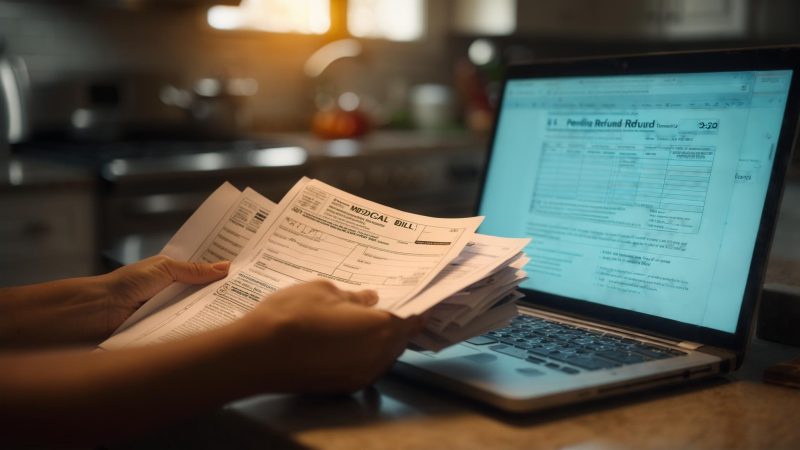
By February 24 — three weeks after filing — Marcus’s Where’s My Refund status had shifted from “Return Received” to a generic processing message with no estimated deposit date. That status held for nearly five more weeks without movement.
According to the Taxpayer Advocate Service, processing delays are most common for returns that include refundable credits, such as the Earned Income Tax Credit or Additional Child Tax Credit, partly due to fraud-prevention reviews mandated under the Protecting Americans from Tax Hikes Act. Marcus’s return included the Child Tax Credit portion that is refundable, which likely contributed to the extended review.
He checked the tracker every morning. He described it as a ritual that had replaced something productive. “I’d get up, make coffee, open the app. Same message. Then I’d close it and feel a little worse than before,” he told me. His wife had started asking about the refund on a near-daily basis, and those conversations, by his account, were not easy.
Meanwhile, the Discover card’s minimum payment came due on March 5. Then the second card’s minimum hit on March 14. Without the refund, Marcus covered them from his regular paycheck — but that meant skipping a $200 transfer he’d planned toward their emergency fund and carrying the full balances forward another month with interest accruing.
What the IRS Letter Actually Said
On March 12, Marcus received a CP05 notice by mail. The CP05 is an IRS form that informs taxpayers their return is being reviewed, specifically to verify income, tax withholding, and tax credits claimed. It does not mean a taxpayer is being audited. However, it does not include a revised estimated deposit date, which Marcus found maddening.
“I teach geometry proofs,” Marcus said. “The whole point is that every step has to be justified. But this process — there’s no logic to it from the outside. You just wait and nothing explains itself.”
He called the IRS on March 18, six days after the CP05 notice date. The automated system told him a representative could not discuss the return until the 60-day review window had elapsed. He hung up and didn’t call back.
The Refund Arrived — Smaller Than Expected
On April 4, 2026 — exactly 61 days after Marcus filed his return — a deposit appeared in his checking account. He was in the middle of grading tests when his phone buzzed with the bank alert.
The deposit was $3,000 even. Not $3,847.
A letter arrived a week later explaining that $847 had been applied to an underpayment from Marcus’s 2022 return — a year when his wife had freelance income that, as Marcus now realizes, was underreported on their joint return. He had no memory of ever receiving a bill for that balance. “Maybe it went to an old address. Maybe I threw it away thinking it was junk mail. I genuinely don’t know,” he told me, without defensiveness, just a kind of tired honesty.
He paid off the Discover card — $1,640 — and made a significant payment on the second card, reducing that balance by $1,100. The remaining $260 went toward a partial replenishment of the emergency fund he’d drained making minimum payments during the wait.
What Marcus Says He Learned — and What He Still Avoids
When I asked Marcus whether he’d changed anything about how he handles his finances going forward, he paused for a long moment before answering. The whiteboard goal in his kitchen has been erased. His wife, he said, now checks the bank account more regularly than he does.
According to IRS direct deposit guidance, the fastest refunds go to taxpayers who file electronically and choose direct deposit — which Marcus did. The CP05 review added roughly five to six weeks onto what should have been a 10–14 day turnaround for an e-filed return.
Marcus said the experience rattled something loose in him — not dramatically, not in a way that changed his behavior overnight, but quietly. He started opening his bank app twice a week instead of avoiding it entirely. He pulled his IRS account transcript online, a step he’d never taken before, and discovered the 2022 balance had been sitting there for over a year. “I could have paid $847 at any point. That’s almost nothing compared to what it would have cost me in interest if they’d just let it ride,” he said.
The credit card balances are lower now. The student loan payments — $487 a month — continue unchanged on an income-driven repayment plan through the federal loan servicer. His wife picked up a few additional tutoring hours in March. The whiteboard in the kitchen has a new goal written on it, though Marcus wouldn’t tell me what it says. “Something more realistic this time,” is all he offered.
Sitting across from Marcus, what struck me most was not the bureaucratic frustration of the delay or even the sting of the offset — it was how a $3,847 refund had become the load-bearing wall of a family’s financial plan for two full months. When it shifted, everything shifted with it. The IRS eventually resolved everything correctly, by the letter of the law. But the law doesn’t account for what happens to a teacher’s February when the money he was counting on is somewhere inside a processing queue, and the bills are still arriving on schedule.
Related: The IRS Says 1 in 5 Eligible Families Miss This Tax Credit Worth Up to $7,830
Related: My Wife Is Due in Four Months and We Have $22K Saved — Here’s the Impossible Math We’re Facing



Leave a Reply