

What would you do if the one check standing between you and losing your home was sitting in a government queue with no estimated arrival date and no one you could call to speed it up?
I met Lester Hensley on a gray Tuesday afternoon in early March 2026, in a conference room at the Southside Community Resource Center on West National Avenue in Milwaukee. The center’s director, Maria Okonkwo, had sent our publication a short email two weeks earlier: “Have a man here, 48, engineer, widowed, behind on property taxes, waiting on a federal refund that’s gone silent. Think it might be a story worth telling.” She was right.
Lester arrived seven minutes early, in a work jacket with a petroleum company logo faded to near-illegibility. He accepted a cup of coffee, set it down, and did not touch it once during the two hours we spoke. He is the kind of person who treats sitting still as a discipline rather than a comfort.
The Situation Lester Was Trying to Solve
Lester Hensley spent roughly twenty years working rotating contracts across Texas and Louisiana as a petroleum engineer — the kind of work that pays well in spurts and demands everything in between. When his wife, Denise, died of ovarian cancer in October 2022, he gave up the contracts and moved back to Milwaukee to be close to his sister and to stay in the house on West Burnham Street that he and Denise had owned together for eleven years.
His two adult children — Marcus, 26, living in Phoenix, and Dana, 24, in Atlanta — had built their own lives. Lester did not ask them for help, and by all indications, the subject was not open for discussion. His income in 2025 came to approximately $28,000, a combination of part-time engineering consulting and a small contract with a Milwaukee-area industrial firm. Below Milwaukee County’s median household income. Enough to cover the basics. Not enough to absorb surprises.
The surprise that started the cascade was a furnace failure in January 2024. The repair bill came to $3,100 — money that had been earmarked for his 2023 Milwaukee County property tax installment. He deferred, planning to catch up by summer. By December 2024, the overdue balance had grown to $4,200, and the county had issued a formal delinquency notice. A tax lien, he knew, would follow if the balance wasn’t addressed by spring 2026.
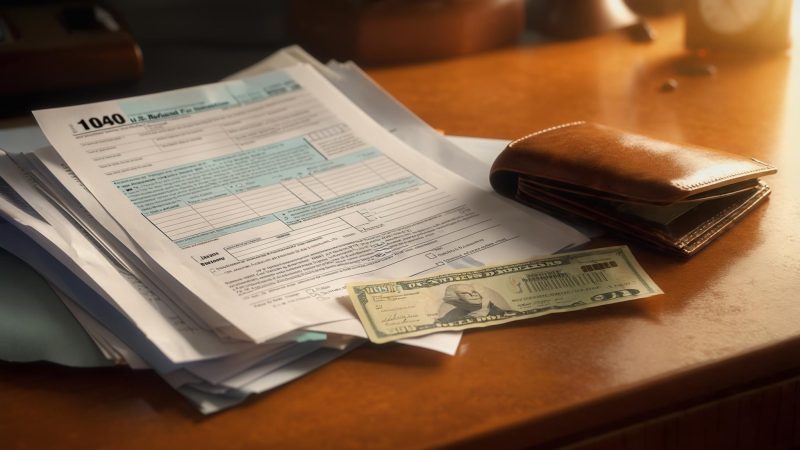
When Lester filed his 2025 federal return electronically on January 31, 2026 — using a free filing service recommended by the community center — the IRS projected a refund of $2,347. His plan was immediate and specific: send $2,200 to Milwaukee County the day the deposit cleared, reduce the delinquent balance to a manageable level, and negotiate a payment arrangement on the remainder. He told his sister he expected the money by February 20.
“I’m not somebody who plans loose,” he told me. “Every dollar I had going out in February was already assigned before January was over. That refund was load-bearing.”
When ‘Approved’ Stopped Meaning What He Thought It Meant
The IRS accepted Lester’s return on February 2. Ten days later, on February 12, the IRS Where’s My Refund tool updated to show his refund as “Approved.” In standard IRS terminology, that status means the refund has been approved for payment and is scheduled for deposit. For most electronically filed returns, the gap between “Approved” and a bank deposit is two to five business days.
February 20 came and went. Then February 28. Then March 3, the day we sat across from each other at the community center. His status on the IRS tool still read “Approved.” The deposit had not arrived. He had checked the tool every morning for nineteen consecutive days.
The IRS generally issues most electronically filed refunds within 21 calendar days of acceptance. That is the standard timeline published on IRS.gov. For Lester, 21 days from his February 2 acceptance date would have been February 23. He was already ten days past that when we first met.
What Was Happening Inside the IRS During the Wait
What Lester could not have known from a government website status tool was that the agency processing his return had undergone a significant institutional contraction. According to reporting by the Boston Globe on the 2026 tax season, the IRS had shed roughly one-quarter of its workforce since President Trump returned to office, cycling through seven different agency leaders in the process. IRS chief executive officer Frank Bisignano had written a letter to the agency’s approximately 74,000 employees announcing a reorganization and new priorities as the filing season opened.
The administration had simultaneously promised American taxpayers larger refunds in 2026. The distance between that promise and the agency’s operational capacity was something Lester was measuring in days on a calendar, not in policy debate points.
One detail in the Globe’s coverage stands out for what it means to someone in Lester’s position: analysts noted that a reduced IRS is “simply outgunned” by wealthier taxpayers who use professional preparers and accountants to navigate complex returns. The delays and friction, in other words, tend to concentrate among ordinary filers — the people least equipped to absorb them.
Finding Help in a System Not Built for Stubbornness
Maria Okonkwo described Lester to me before our meeting as someone who “will spend twelve hours researching a problem online before asking one person five minutes of help.” Lester did not dispute this characterization. He had already spent considerable time on the IRS website, read two Reddit threads about refund delays, and called the IRS’s main line twice — reaching hold music both times before hanging up.
“Financial advice is for people who have choices,” he said, when I asked whether he’d considered talking to a tax professional earlier in the process. “I don’t have choices. I have math.”
The community center eventually connected him with a volunteer counselor through the VITA program — the IRS’s Volunteer Income Tax Assistance network, which provides free tax preparation and support to filers earning approximately $67,000 or less. The VITA counselor reviewed his return and found no errors. The $2,347 figure was accurate and included the Earned Income Tax Credit, which Lester qualified for at his income level. There was no amended return to file, no missing documentation to submit. His case was simply in the queue.
The Deposit, the Math, and What Didn’t Resolve
When I called Lester on the afternoon of March 18, he picked up on the second ring. The deposit had cleared that morning. He had already transferred $2,200 to Milwaukee County’s online payment portal, reducing his delinquent balance to approximately $2,000. The county had agreed to a six-month installment arrangement on the remainder — roughly $334 per month, which he described as “tight but survivable.”
The remaining $147 of his refund went toward a past-due utility bill. His furnace — the original source of this entire cascade — still needs a maintenance check he has been postponing since October 2025. There is no emergency fund. The small buffer Denise had always insisted they keep has not been rebuilt since her death.
“It’s not a win,” Lester told me, with the same flat candor he had shown throughout every conversation. “It’s more like — I didn’t lose. That’s different.”
He paused before adding something I hadn’t expected: “I keep thinking about people who got less patient than me. Who did something drastic in week three because they couldn’t hold on. That’s the part nobody writes about.”
What His Wait Tells Us About the 2026 Filing Season
Lester Hensley is not an outlier defined by bad luck alone. He is, in many respects, representative of a category of filer the tax system was not designed with at the center of its attention: low-income, filing accurately and on time, dependent on a refund for immediate financial stability, and without the resources to hire anyone to advocate on his behalf when the system slows down.
The 2026 filing season is playing out against an unusual institutional backdrop. The IRS has lost a significant portion of its staff, gone through multiple leaders in rapid succession, and is simultaneously being asked to process roughly 150 million individual returns while delivering on public promises of larger, faster refunds. Those two objectives are in tension in ways that show up not in press releases but in the lived experience of people like Lester checking a website at 6 a.m. before work.
“Math says: file early, file right, and hope somebody on the other end is paying attention,” he told me, when I asked whether the experience had shifted anything in how he thought about the tax system. He did not say it with bitterness. He said it like a man who has learned to take the system as it is, not as it’s advertised.
I left that first meeting at the community center thinking about the furnace. About a $3,100 repair bill in January 2024 that, in a different financial context, would have been an inconvenience. About the way a single month’s shortfall can compound, over two years, into a threatened home, a deferred refund, and a man sitting across from a journalist because that was the only avenue left that didn’t require him to ask his kids for money.
The refund arrived. The lien threat, for now, is gone. That is the resolution this story has. Whether it’s a happy ending depends on what you count as the story.



Leave a Reply