
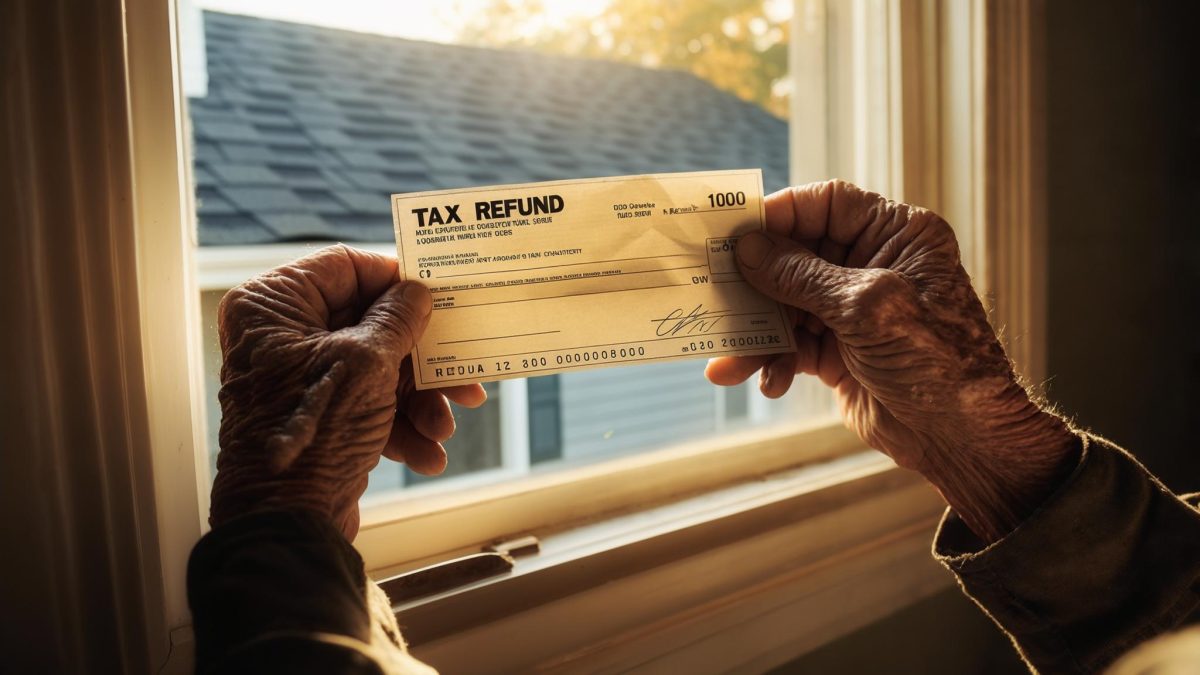
The 2026 tax filing deadline is April 15, and for millions of Americans the annual wait for an IRS refund is anything but a windfall — it is a calculation. When I arrived at the storage yard in Tucson’s south side that serves as Carlos Reeves’s field office, he was reviewing a roofing estimate on a clipboard and talking to one of his crew leads in Spanish. He shook my hand, gestured to a folding chair across a card table, and apologized for the noise. A social worker at the Pima County assistance office had suggested I speak with him a week earlier, telling me quietly that his situation captured something she saw constantly: a working family with real income and almost no cushion.
Carlos is 48, married, the father of three children ages 11, 14, and 16. He has run his landscaping operation for eleven years, and his 2025 gross revenue topped $340,000. He employs nine people full-time and holds commercial contracts with several office parks and residential HOAs across the metro. By any surface measure, he is doing well. “That’s the part that’s hard to explain,” he told me. “People hear those numbers and they think you’ve got it figured out. But the expenses scale with the income. The stress scales with it too.”
Three Problems, One Expected Check
Carlos had filed his 2025 federal return electronically on February 4, 2026, with a CPA he has used for six years. His anticipated refund was $4,847. That number had been mentally allocated three separate times before it arrived.
The first claim on it was the roof of the family’s four-bedroom home in Tucson’s Midvale Park neighborhood. Water stains had been spreading across the living room ceiling since the previous monsoon season. Two contractors inspected the damage; the lower estimate came in at $14,200 for a full tear-off and replacement. “I patched it twice with stuff from Home Depot,” Carlos said, without any particular embarrassment. “My wife banned me from the roof after I slipped last summer. She’s probably right about that one.”
The second problem was a 2022 Arizona state income tax assessment that Carlos had disputed and ultimately lost. The $6,700 balance had been referred to the Arizona Department of Revenue for collection. His CPA had flagged a specific risk: the state could submit the debt to the federal Treasury Offset Program, which allows qualifying government debts to be pulled directly from an IRS refund before it ever reaches the taxpayer. According to the IRS refund information page, when an offset occurs, the agency issues a notice explaining the reduction — but the money is already redirected.
The third problem was a 2021 Ford F-250 financed at the peak of used-truck pricing. Carlos owed $28,500 on a vehicle recently appraised at roughly $18,000. He was current on payments, but completely locked in. “I can’t sell it, I can’t trade it, and if I miss a payment the business stops running,” he said. That one wasn’t going to be touched by any refund check. But the roof deposit and the offset risk — those were the numbers that had him checking his phone at two in the morning.
The $2,000 Stimulus Rumors That Complicated Everything
While Carlos waited for his refund to process, his social media feeds filled up with posts about a possible $2,000 stimulus check funded by tariff revenue. He texted me a screenshot in late February. “Is any of this real?” he wrote. “Because if it is, I can breathe for a minute.”
The honest answer was complicated. The concept originated when the Trump administration floated the idea of distributing a portion of tariff revenues directly to American households — described in various reports as a “tariff dividend.” As the Austin American-Statesman reported, the proposal had circulated widely but had not been enacted into law during the filing season. No IRS direct deposit authorization for a $2,000 payment existed as of April 2026.
Carlos admitted he had spent nearly two weeks mentally incorporating the potential $2,000 into his repair planning. “I had already decided what I was going to do with it,” he said, with a short, self-aware laugh. “That’s how you set yourself up — spending money that doesn’t exist yet. I’ve been doing this long enough to know better.” Once I confirmed the uncertainty, he reset his expectations to the refund he knew was real and coming.
Checking the IRS Tracker Every Morning at 6 a.m.
Carlos’s return was accepted by the IRS on February 4, the same day he filed. His CPA told him to expect the deposit within 21 days if no issues arose — standard processing time for an e-filed return with direct deposit, consistent with published IRS guidelines. What followed was a daily ritual with the “Where’s My Refund” tool that he described as both reassuring and maddening.
The deposit arrived 14 days after filing — well within the standard window. But the amount was $700 short. The offset had been smaller than Carlos or his CPA had feared; the full $6,700 balance was not taken. “I knew it might happen,” Carlos told me. “But there’s a difference between knowing it could happen and watching $700 disappear before you can do anything about it.” The notice came four days later. He read it once, set it on his desk, and went back to work.
What the $4,147 Actually Fixed — and What It Left Alone
With $4,147 in hand, Carlos made two moves immediately. He paid $2,500 as a deposit to the roofing contractor — enough to get the job scheduled for the third week of March. The remaining $11,700 balance would come from business cash flow over two billing cycles, which his CPA considered achievable if spring commercial contracts held. The second move was quieter: he directed $900 toward the Arizona state balance, trying to reduce the remaining debt before it could affect his 2026 filing.
The truck remained exactly where it was — $10,500 underwater with no near-term solution. Carlos did not dwell on it. “I need that truck,” he said. “So I just don’t think about it.” That kind of triage — deciding which problem to acknowledge and which to set aside — seemed to be a skill he had developed over years of running a tight operation.
He had been following coverage of possible 2026 tax code changes with guarded interest. As CNBC reported in January 2026, proposed legislation tied to what has been called the “big beautiful bill” could expand deductions and credits in ways that might benefit small business owners in future filing years — though the specifics depend on final legislative language. Carlos told me he was watching but not planning. “I learned my lesson with the tariff check thing,” he said. “Nothing counts until it’s in the account.”
Before I left the storage yard that afternoon, Carlos walked me to the fence line and pointed in the direction of his neighborhood. He talked about his three kids and how deliberately he had kept them away from the financial specifics of the past two years. His oldest, the 16-year-old, had sensed something. “She knows it’s been tight,” he said. “But she doesn’t need to know the details. That’s mine to carry.”
That sentence stayed with me on the drive back across Tucson. Carlos Reeves earns real money, employs real people, and pays his bills. But the gap between his income and his actual margin is a story that doesn’t show up in a tax return. A $4,147 refund did not fix his roof, eliminate his debt, or resolve his truck loan. It gave him a few more months to fix those things himself — which, from everything he told me, is exactly what he intends to do.
For anyone currently waiting on a 2026 refund, the IRS “Where’s My Refund” tool remains the only official real-time tracker. If you have outstanding government debts that may trigger an offset, the Bureau of the Fiscal Service’s TOP call center at 800-304-3107 can tell you in advance whether a debt has been submitted for collection. And if you are waiting on a stimulus check you read about online, confirm it with an official source — like USA.gov/benefits — before building any financial plan around it.




Leave a Reply