

Roughly 16 million Americans who work as independent contractors or freelancers fail to make quarterly estimated tax payments each year, according to the IRS self-employment tax center — and many of them don’t realize the gap until they’re staring at a balance due in April. Grace Nakamura was one of them.
I sat down with Grace on a rainy Tuesday afternoon in Portland, at the kind of coffee shop where the menu is written entirely in chalk and the music is just loud enough to require leaning in. She was 38, clear-eyed, and more candid about her finances than most people I interview. She had agreed to talk because, as she put it, she wished someone had told her what she was about to tell me.
The Pivot That Changed Everything — Including Her Taxes
Three years ago, Grace walked away from a stable HR management role at a mid-size Portland tech company. The salary was solid, benefits were good, and she was miserable. She had been teaching yoga on weekends for years, and had built a modest wellness blog with a loyal following. When her daughter turned four, Grace made the call: she would go full-time on what she loved.
Her partner earns roughly $140,000 annually as a software engineer, which keeps the household afloat. Grace brings in approximately $18,000 per year — a mix of studio class fees, private sessions, and blog sponsorships paid out on 1099 forms. For the first two years, tax season felt manageable. Then 2025 arrived.
“I thought because we filed jointly and my partner withholds from his paycheck, it would all even out,” Grace told me, wrapping her hands around her coffee cup. “I genuinely did not understand that my income was being calculated separately for self-employment tax purposes.”
She’s not alone in that confusion. The IRS requires self-employed individuals to pay both the employee and employer portions of Social Security and Medicare — a combined 15.3% on net self-employment earnings above $400. For Grace, that alone accounted for roughly $2,320 before any income tax liability was layered on top.
How the 2025 Tax Year Became a Wake-Up Call
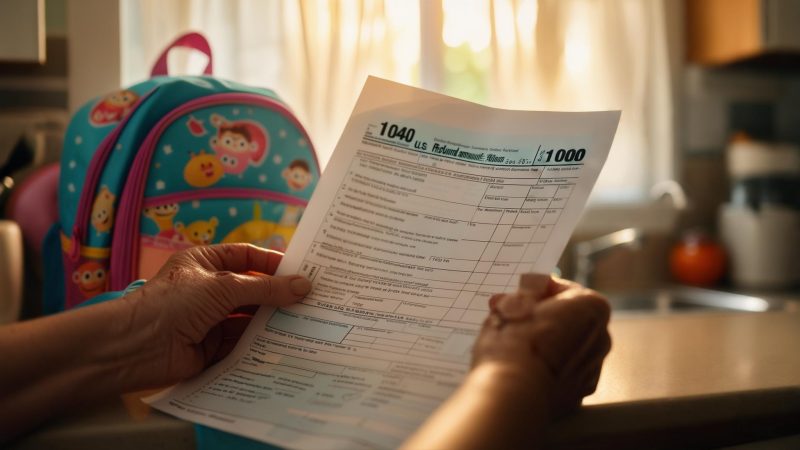
Grace and her partner file jointly using Form 1040, with her self-employment income reported on Schedule C. Her blog revenue — paid by brands in quarterly installments — and her class fees came in across the year without any withholding. She made no estimated quarterly payments in 2025. Not in April. Not in June. Not in September. Not in January 2026.
When her tax preparer ran the numbers in late February 2026, the balance due came out to $2,412 — a combination of self-employment tax and a small additional income tax liability after accounting for her partner’s withholding. An underpayment penalty of roughly $190 was added on top, calculated using IRS Form 2210.
“I remember the exact moment,” Grace said. “My tax preparer turned her screen toward me and I just felt the floor drop out. We don’t have savings like that sitting around. My partner handles the big bills, and I handle my own small expenses. That $2,400 wasn’t somewhere I could just go grab it.”
The Friction Between Values and Financial Reality
Part of what makes Grace’s story complicated — and honest — is that the tax bill didn’t arrive in a vacuum. It arrived alongside a broader reckoning about how she and her partner think about money. Grace describes herself as someone who values experiences and meaning over financial accumulation. Her partner is more pragmatic, but not controlling. Their dynamic works, she said, except when it doesn’t.
“We have philosophical disagreements,” she told me carefully. “He’s very ‘plan for every scenario.’ I’m more ‘we’ll figure it out.’ The tax thing was a moment where I had to admit that my approach had a real cost.”
That cost extends beyond the IRS bill. When I asked Grace about life insurance and disability coverage, she paused longer than felt comfortable. She and her partner have neither. They don’t have a will. Their daughter is seven. Grace said she knows — has always known — that if something happened to her partner, the financial structure of their life would collapse. He carries the health insurance through his employer, the mortgage, the car payments.
“I don’t like thinking about it because thinking about it means admitting how precarious things actually are,” Grace said. “And I’ve built this whole identity around not being the anxious corporate person anymore. So there’s this tension between who I tell myself I am and what I actually feel at 2 a.m.”
Working Through the IRS Payment Options
With the April 15, 2026 filing deadline approaching, Grace and her tax preparer looked at what options the IRS provides for taxpayers who owe but can’t pay in full. According to IRS installment agreement guidelines, taxpayers who owe $50,000 or less in combined tax, penalties, and interest can apply online for a payment plan without providing financial documentation.
Grace qualified easily. She applied through the IRS Online Account tool and was approved for a 24-month installment agreement. Her monthly payment came out to approximately $108, with interest accruing at the current rate. It wasn’t painless — but it was manageable.
For the 2026 tax year, Grace said she’s doing things differently. She met with her tax preparer in January and walked out with four calendar reminders — April 15, June 16, September 15, and January 15, 2027. She’s setting aside roughly $350 per quarter from her class fees and blog payments into a dedicated account she calls her “IRS fund,” a name she said feels slightly absurd but keeps her focused.
What Grace Took Away From Tax Season — And What Still Worries Her
When I asked Grace what she wished she’d known before making the career pivot, she didn’t hesitate. “I wish someone had told me that the IRS doesn’t care about your philosophy,” she said, laughing for the first time during our conversation. “It’s not personal. It’s math. And the math doesn’t pause for a values alignment.”
The installment plan is running. The 2026 estimated payments are scheduled. But the larger questions Grace raised — about the household’s complete absence of disability insurance, life insurance, and estate planning — remain unresolved. She described those as the next mountain, one she’s not ready to climb yet, though she knows the slope is getting steeper the longer she waits.
“My daughter is seven,” Grace told me as we wrapped up. “If something happened to her dad tomorrow, we would lose the house. I know that. I sit with that. I just haven’t figured out how to make myself act on it without feeling like I’ve become the version of myself I was trying to leave behind.”
There’s no neat resolution to offer there, and I won’t pretend otherwise. Grace left our conversation with a payment plan in place and a clearer picture of her quarterly obligations — but also carrying the weight of everything she still hasn’t addressed. She’s not the only person in that position. She’s just one of the few willing to say it plainly.
Related: A Denver Nurse Paying $1,400 a Month for Daycare Didn’t Know She Qualified for a $2,000 Tax Credit
Related: I Thought I Made Too Much for Help. A Denver Nurse Found $4,200 She Didn’t Know She Had



Leave a Reply