
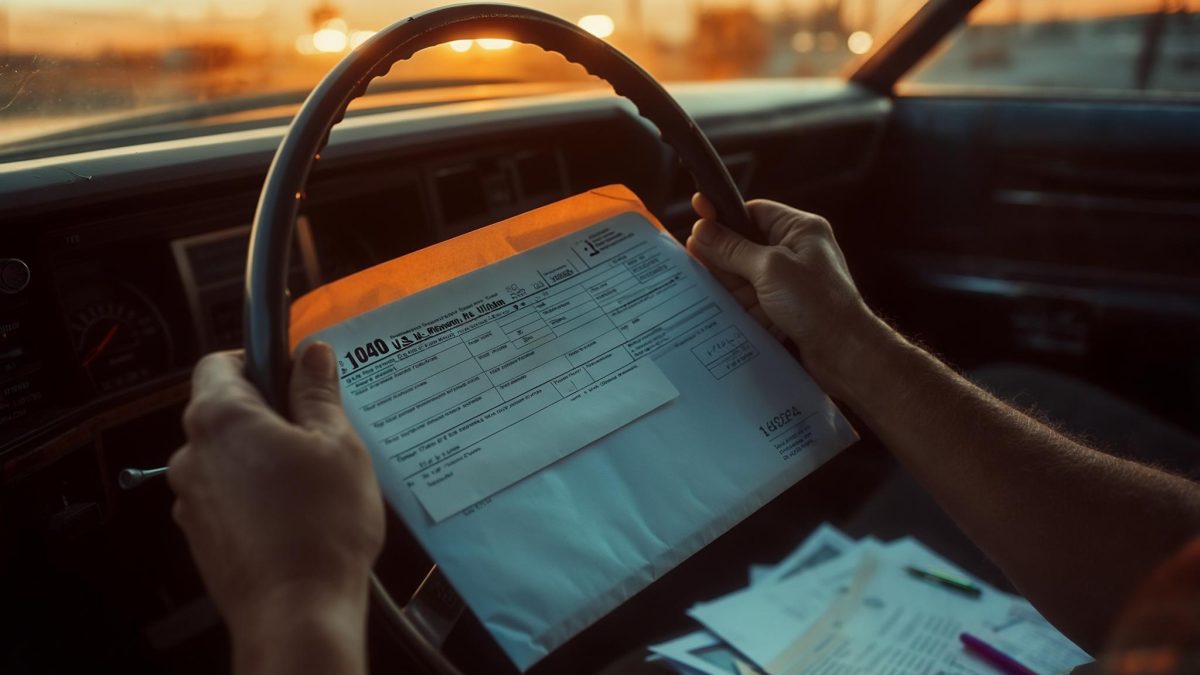
Roughly one in four gig economy workers who file taxes each year are surprised by either an unexpected bill or a dramatically reduced refund, according to estimates from tax professionals who work with self-employed filers. Most of them never saw it coming — and neither did Nolan Kowalski.
I first heard Nolan’s name in the front seat of a delivery van. I was riding along with a Meals on Wheels volunteer route in Little Rock, Arkansas, in late March 2026 when the volunteer coordinator, a woman named Diane, mentioned a regular driver on her roster. “There’s this guy, Nolan,” she said. “He does Uber during the day and volunteers one evening a week even though he can barely afford gas. He’s been going through something with his taxes that’s just breaking him down.”
I reached out to Nolan the following week. He agreed to talk, though he warned me upfront he wasn’t sure he had much of a story. “It’s just the same thing everyone’s dealing with,” he told me before we even sat down. That turned out to be exactly why his story was worth telling.
A Budget Built on an Expected Refund
When I met with Nolan Kowalski at a diner on Cantrell Road in Little Rock on April 2, 2026, he had a folder of tax documents on the table before I even ordered coffee. He’s 52, soft-spoken, and carries the particular exhaustion of someone who stopped being surprised by bad news a long time ago.
Nolan drives for Uber full-time — six days a week, averaging roughly 48 hours — and has done so since 2021, when the graduate program in public administration he’d enrolled in at the University of Arkansas at Little Rock didn’t translate into the government job he’d hoped for. He graduated in 2020 with $34,000 in federal student loan debt. The job market had other plans.
His household income in 2025 came in at approximately $43,700 — net of Uber’s platform fees, but before self-employment tax. His wife, Carla, provides full-time care for their 14-year-old son Marcus, who has a severe autism spectrum diagnosis requiring constant supervision. Carla cannot work outside the home. Their mortgage on a three-bedroom house in the Geyer Springs neighborhood runs $1,340 a month, and they were three weeks behind when Nolan filed his 2025 federal return on February 6, 2026.
“I’d done the math,” Nolan told me, tapping the folder. “With the Child Tax Credit, the student loan interest deduction, and what I thought I’d overpaid in estimated taxes — I was counting on about two thousand, maybe twenty-one hundred dollars back. That was going to cover the mortgage gap and keep us out of the late fee cycle for at least another month.”
What the IRS Form 1099-K Changed
The problem, as Nolan eventually pieced together, started with a reporting threshold change that caught a significant number of gig workers off guard in the 2025 tax year. Under the American Rescue Plan’s revised rules, payment platforms including Uber are required to issue Form 1099-K for any driver earning more than $5,000 in a calendar year — a threshold that had been phased down from the prior $20,000 floor. Nolan received a 1099-K from Uber showing $47,214 in gross payments for 2025.
The figure looked unfamiliar. Nolan had calculated his income based on what actually landed in his bank account after Uber’s service fees and commissions — closer to $43,700. The gross figure on the 1099-K was higher, and when his tax software auto-populated the form, it created a mismatch that the IRS’s automated matching system flagged.
Nolan had used a free online tax filing service. He entered what he thought were the right numbers, clicked through the prompts, and submitted. “It said I was getting twenty-one hundred and forty dollars back,” he said. “I remember the number exactly because I told Carla that night, and she cried a little. We hadn’t had that kind of breathing room in a long time.”
The CP2000 Notice That Arrived Eight Weeks Later
On April 1, 2026 — the day before I met him — Nolan received a CP2000 notice from the IRS. It’s a notice the agency sends when income reported on a return doesn’t match what third parties (like Uber) have reported to the IRS. It is not an audit, but it functions like a financial gut punch for people who’ve already spent the refund in their heads.
The notice proposed an adjustment of $1,786 to Nolan’s tax liability, based on the discrepancy between the gross 1099-K figure and what he’d reported as income. It also flagged his student loan interest deduction of $1,240 as potentially ineligible, though that was listed as a secondary item pending his response.
According to IRS documentation on CP2000 notices, recipients have 60 days to respond either agreeing with the proposed changes or disputing them with supporting documentation. Nolan had 59 days left when he called me back to say he’d gotten the letter.
Piecing Together the Documentation
What happened between the CP2000 letter arriving on April 1 and my meeting with Nolan on April 2 was a compressed, anxious scramble through receipts, Uber driver earnings statements, and a phone call to a VITA (Volunteer Income Tax Assistance) site in North Little Rock that Nolan found through a library flyer.
The VITA volunteer — a retired accountant named Gerald — walked Nolan through what the IRS actually needed to see. The core issue was documentable: Uber’s own driver portal generates an annual earnings summary that breaks down gross trip fares, Uber’s service fee (typically 25–27% of each fare), and the net amount deposited to the driver. The difference for Nolan in 2025 was $3,514 — money Uber collected as fees that Nolan never touched but that appeared on the 1099-K gross figure.
“Gerald basically said, ‘You didn’t do anything wrong, you just needed one more piece of paper,’” Nolan told me. “That’s a hard thing to hear when you’ve already spent two months thinking you were about to get your head above water.”
Nolan mailed his CP2000 dispute response on April 7, 2026, with a printed copy of his Uber annual earnings summary, a handwritten explanation, and a recalculated Schedule C showing the corrected net income of $43,700. According to IRS VITA program information, sites like the one Nolan used provide free tax assistance to people generally earning under $67,000 annually.
In the meantime, the IRS had released a partial refund — $314 — which deposited to Nolan’s account on April 5. It represented what the IRS was willing to release before the CP2000 dispute was resolved. The remaining balance, if his dispute is accepted, would return approximately $1,826 more.
What Nolan Is Still Carrying
The CP2000 was solvable, at least on paper. What’s harder to resolve are the other financial pressures stacked beneath it. The mortgage is now current — Carla’s sister lent them $1,500 in early March — but Nolan still owes $34,000 on his student loans, and he’s on an income-driven repayment plan that pauses his payments but doesn’t reduce the principal meaningfully. He has no retirement savings to speak of: “I had a 401(k) from a job I left in 2019,” he told me. “I cashed it out when Marcus needed a specialized therapist. It was about eleven thousand dollars. I’d take it back if I could, but I wouldn’t.”
He’s 52. Carla is 49. Marcus will need supported care for the rest of his life. The math — even on the best days — doesn’t close.
That numbness — the kind that comes not from indifference but from sheer repetition of hardship — was the thing that stayed with me after I left the diner. Nolan folded his documents back into the folder, tucked it under his arm, and said he had a 1:45 p.m. pickup on the east side. He pulled out his phone, checked the Uber app, and walked out into the midday sun without looking back.
I watched him go and thought about the $1,826 that may or may not arrive in his bank account sometime this summer, once the IRS finishes processing a dispute about fees he never actually collected. It’s real money. It matters. It just isn’t enough — and Nolan is too tired to pretend otherwise.
What Gig Workers Filing in 2026 Should Know About 1099-K Forms
Nolan’s situation reflects a documentation gap that tax preparers working with gig economy filers describe as increasingly common since the 1099-K threshold dropped. The gross figure on a rideshare 1099-K will almost always be higher than a driver’s actual take-home — sometimes by thousands of dollars — because it includes platform fees that were collected by the app, not the driver.
The IRS has maintained that drivers can and should deduct those fees on Schedule C as a business expense. The practical issue is that many drivers using free or simplified filing software don’t realize the 1099-K amount needs to be reconciled against their actual earnings summary from the platform’s driver portal.
- Download your annual earnings summary directly from the Uber, Lyft, or DoorDash driver portal each January — it breaks down gross fares versus net deposits
- The difference between gross fares and net deposits represents platform service fees — those are deductible on Schedule C as “commissions and fees”
- If you receive a CP2000 notice, you have 60 days to respond — silence is treated as agreement with the IRS’s proposed adjustment
- Free VITA tax assistance sites serve filers earning under approximately $67,000 and can help with CP2000 disputes at no cost
- The IRS “Where’s My Refund” tool at IRS.gov/refunds updates once daily and will reflect review status changes before any notice arrives by mail
None of this is comfortable knowledge to need. But for the roughly 1.5 million full-time rideshare drivers in the United States — most of them working without the safety net of employer-matched retirement accounts, paid leave, or HR departments — it’s knowledge that can mean the difference between a refund that arrives and one that disappears into a dispute process that drags through summer.
Nolan knows that now. He learned it the hard way, the way he’s learned most things since 2020. Slowly, expensively, and without much choice in the matter.
Related: He Got a Raise, Spent More, Lost His Overtime — Then Came a $3,800 IRS Bill
Related: She Left USPS at 30 With $52,000 in Student Loans and a $1,847-a-Month COBRA Bill — and She’s Numb to All of It

Leave a Reply