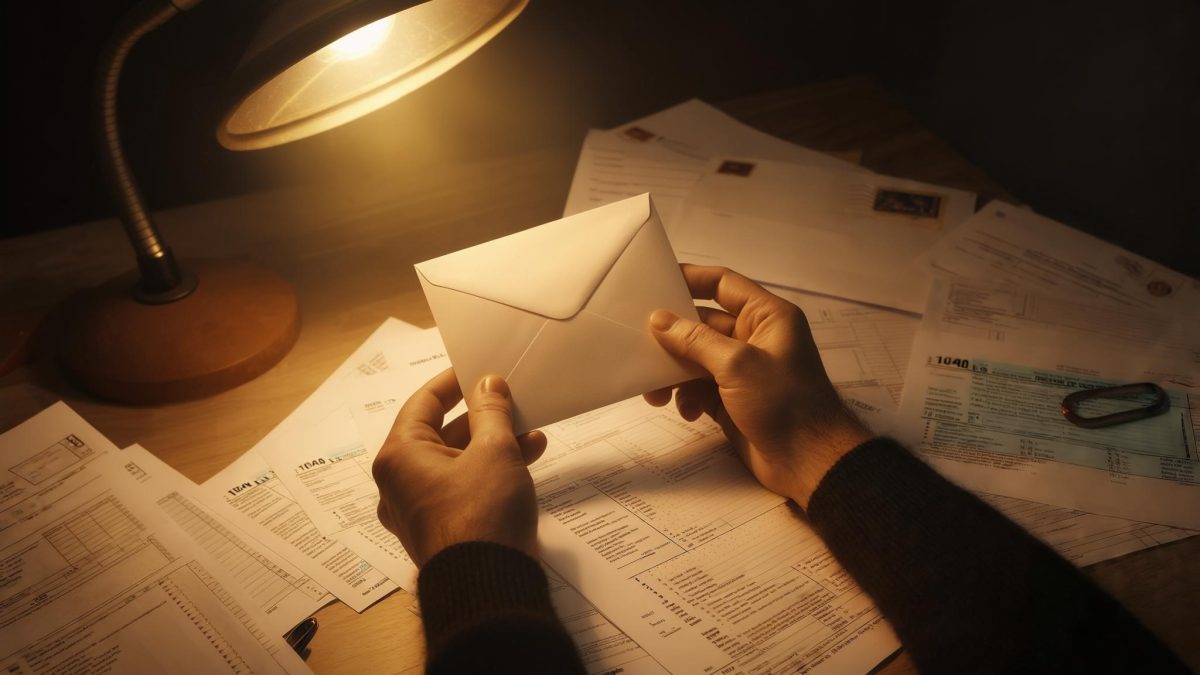
Have you ever built an entire financial plan around money you assumed was already yours — only to find out the government had other ideas? I met Curtis Chen-Ramirez in February of this year through a referral from the Orange Mound Community Resource Center in Memphis, Tennessee. A staff coordinator there had flagged his story as something worth reporting. When I sat down with Curtis at a folding table in the center’s back room, his two-year-old daughter Lily asleep in a stroller beside him, he pulled out a manila folder and slid it across the table without saying a word. Inside was a CP21B notice from the IRS dated January 9, 2026, and a Treasury Offset Program notification showing his entire expected refund had been seized.
Curtis is 35 years old and has been driving for Uber full-time since 2022, logging between 40 and 55 hours a week on the roads around Memphis. He files as a sole proprietor using Schedule C and, after mileage deductions, typically sees a modest refund. For the 2025 tax year, he’d run the numbers himself in December and estimated he was owed roughly $3,200 — a figure he’d verified with a free tax prep volunteer at this same community center. He had already mentally allocated it: $1,100 toward a transmission repair on his 2018 Honda Accord, $900 to cover two months of his daughter’s daycare while he figured out a subsidy application, and the remaining $1,200 as a small emergency buffer.
None of that happened. On February 3, 2026 — the date his direct deposit was scheduled based on the IRS Where’s My Refund tracker — Curtis received a $0.00 deposit and, in the same day’s mail, a notice from the Bureau of the Fiscal Service explaining the offset. The total amount seized: $3,187.44. The stated reason was a defaulted federal student loan balance tied to an account he had co-signed with his former partner in 2019.
The Debt He Never Saw Coming
Curtis and his ex-partner had been together for four years. When they separated in late 2023, shortly after Lily was born, the financial separation was messy — but Curtis believed they had untangled the major liabilities. What he didn’t know was that a private student loan his ex had refinanced into a federally-held consolidation loan in early 2023 still carried his name as a co-borrower. His ex had stopped making payments in mid-2024 without telling him.
“I didn’t even know that loan existed in that form,” Curtis told me, his voice measured but tight. “She refinanced it while we were still together. I signed something — I think I signed something — but I never got any statements, never saw a balance, never heard from a servicer. And then it just showed up and took everything.”
According to the Bureau of the Fiscal Service, the Treasury Offset Program collected over $5.2 billion in delinquent debts through tax refund offsets in fiscal year 2023 alone. Co-borrowers on defaulted federal student loans are fully liable regardless of who made — or stopped making — payments. Curtis had no idea this exposure existed on his credit profile until the offset notice arrived.
Navigating the IRS and Student Loan Servicer at the Same Time
After the initial shock, Curtis did something that surprised me about him: he got organized. Within 48 hours, he had filed an inquiry with the Bureau of the Fiscal Service’s TOP call center (800-304-3107), requested a copy of the offset documentation, and tracked down the loan servicer — Default Resolution Group, under the Department of Education — through the Federal Student Aid website. He wasn’t panicked. He was methodical, even as he was furious.
“I knew getting angry at the IRS wasn’t going to get me my money back,” he said. “So I just started making calls and writing things down. That’s all I could do. I’ve got a two-year-old. I can’t fall apart.”
What he learned through those calls was both clarifying and discouraging. The offset was legally valid. Because he was a co-borrower on a federally-held loan in default, the Treasury Offset Program had the authority to seize his refund in full. The only path to challenging it would be to prove the underlying debt was itself invalid — not merely that he hadn’t known about it. His options were limited.
What the Offset Actually Means for a Gig Worker’s Tax Situation
Curtis’s situation is complicated by the nature of his work. As an Uber driver, he files Schedule C and pays self-employment tax — both the employee and employer portions of Social Security and Medicare, which together equal 15.3% of net self-employment income. According to the IRS self-employment tax center, gig workers who don’t make quarterly estimated payments can face underpayment penalties on top of their regular tax bill.
Curtis had been making quarterly estimated payments throughout 2025 — $380 per quarter — which is part of why he had a refund coming at all. That discipline, built carefully over three years of driving, was effectively wiped out in a single offset action tied to someone else’s financial decisions.
For gig workers specifically, the refund often functions as a de facto savings vehicle — a forced accumulation of capital that arrives in a lump sum. When it disappears without warning, the downstream effects are disproportionate. Curtis had no daycare backup plan. He’d already scheduled the car repair. The ripple was immediate.
Where Curtis Stands Now — and What He Wishes He Had Known
When I followed up with Curtis in late March 2026, he was in a holding pattern. He had entered preliminary conversations with Default Resolution Group about a loan rehabilitation program, which would require nine consecutive on-time payments of an income-based amount — in his case, approximately $85 per month — before the loan would be removed from default status. His refund, however, was not coming back regardless of whether he completed rehabilitation. The offset had been applied permanently to the outstanding balance.
“The thing that bothers me most,” Curtis told me, “isn’t even the money. It’s that I did everything right. I made my estimated payments. I filed on time. I kept records. And it still happened because of something I had no visibility into.” He paused, smoothing the edge of a document on the table. “I keep wondering what else is out there with my name on it that I don’t know about.”
His immediate workaround was grinding. In February, he extended his driving hours to 58 hours per week to absorb the daycare gap. The transmission repair got pushed to a payment plan through a local shop that agreed to $200 a month. He applied for a Shelby County childcare assistance subsidy, which he said he’d been putting off because the paperwork felt overwhelming when he was already exhausted from driving.
When I asked Curtis what he would tell another gig worker who expected a refund this season, he was direct. “Pull your credit report before you file. Check Federal Student Aid to see if your name is attached to anything. If you ever co-signed anything with someone you’re not with anymore, find out where that loan is now.” He said it without bitterness, almost like a checklist — the same methodical tone he’d had at the start of our conversation.
Sitting with Curtis in that community center, I kept returning to the same thought: he is exactly the kind of person the tax system is supposed to work for. He earns his income honestly, reports it accurately, pays quarterly, claims only what he’s entitled to. The offset that erased his refund wasn’t a failure of his behavior — it was a gap in visibility that the system doesn’t currently close. His daughter will be three this summer. He’s already thinking about what next year’s refund might look like, and whether it will actually arrive.
That combination — hope and wariness — is the most honest thing I’ve heard in a long time from someone navigating a tax system that, for all its complexity, still doesn’t send a simple warning before it takes what you were counting on.
Related: Behind on Property Taxes and $67,000 in Student Debt: One Tampa Mom’s Search for Economic Relief
Related: My Workers’ Comp Claim Was Denied — Now a Debt Collector Is Taking 25% of My Freelance Income




Leave a Reply