
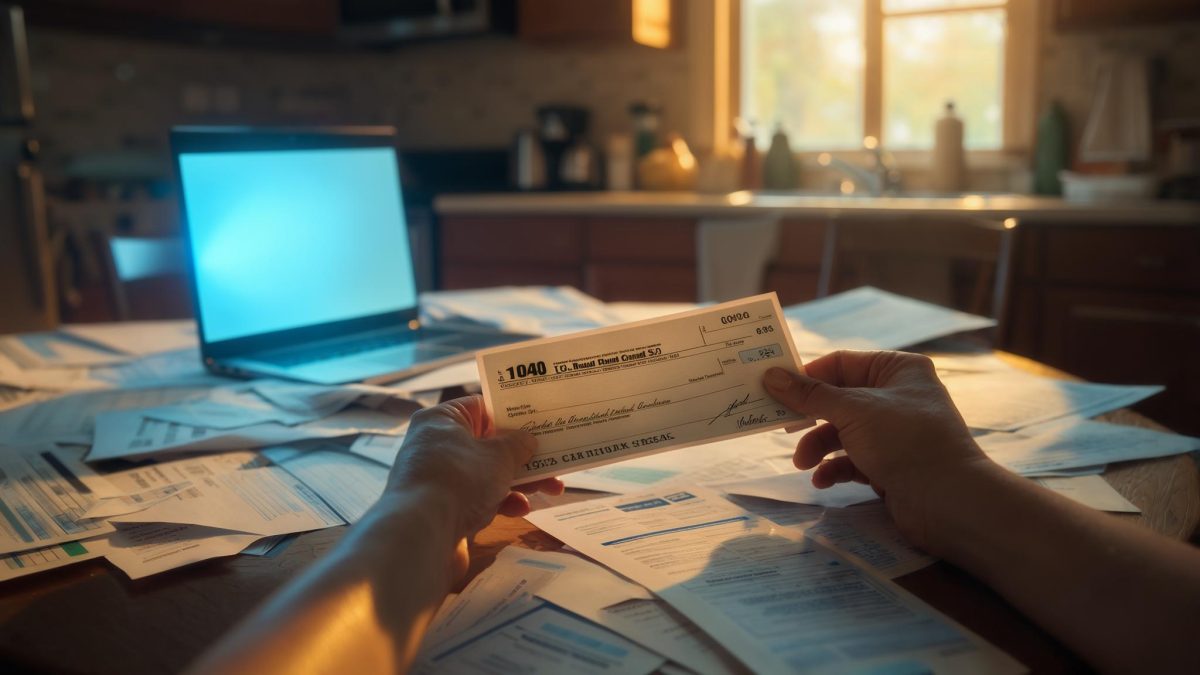
More than 80 percent of refunds issued during the 2026 filing season arrived in under 21 days, according to IRS filing season data — but for Americans carrying debt and depending on that deposit, even a technically smooth processing window can feel like an open wound.
I met Doris Novak on a Thursday afternoon in late February, somewhere between the canned soup aisle and the bread display at a Homeland grocery on the northwest side of Oklahoma City. She was squinting at her phone with the focused patience of someone who has explained long division to teenagers for three decades. I asked if she was checking the IRS Where’s My Refund portal. She let out a short laugh that didn’t quite reach her eyes and said, “Every single day.” That moment led to coffee, then to this story.
A Teacher’s Budget Built Around One Deposit
Doris Novak is 65 years old, a public high school math teacher in Oklahoma City, and she has spent nearly thirty years in a classroom. She is engaged to Marcus, who is finishing a graduate degree and not yet drawing a full income. Together, they run a household she describes as “technically fine, until something breaks.”
Something broke in October 2025. Doris spent two nights in the hospital after a cardiac arrhythmia episode — frightening, but not a heart attack. After insurance, her out-of-pocket exposure came to $4,800, which she put on a credit card to protect the savings she and Marcus would need if another emergency followed. “I had the money,” she told me, “but I couldn’t bring myself to wipe it out completely. You never know what’s next.”
By the time she sat down to file her taxes on February 3, 2026, that $4,800 balance had become the fixed point around which every financial conversation in her household circled. Her expected federal refund — $2,340, driven by withholding from her teacher’s salary and a small deduction for classroom supplies she purchased out of pocket — wasn’t going to clear the debt. But it was going to make it feel survivable.
She e-filed through tax software on February 3 and received an acceptance confirmation within 24 hours. Then the waiting began.
The $2,000 Stimulus Rumors That Scrambled Her Plans
Within days of filing, Doris started seeing social media posts and news headlines suggesting that Americans might receive a $2,000 stimulus payment tied to tariff revenue — sometimes called a “tariff dividend” — in April 2026. According to reporting from app.com, more than $166 billion in tariff revenue had become the center of the proposal, with figures ranging from $1,700 to $3,000 circulating online. No legislation authorizing such a payment has been passed as of this writing, and the concept remains unconfirmed policy.
Doris — who taught herself to read IRS notices the same way she once learned calculus, methodically and line by line — spent hours trying to parse what was real. She read news articles, checked government sites, and asked colleagues in the teachers’ lounge. “I kept thinking, if there’s an extra $2,000 coming, maybe I should hold off before deciding what to do with the refund,” she told me. “But nobody could give me a straight yes or no.”
The uncertainty caused her to pause her plan to immediately pay down the credit card the moment her refund landed. She was waiting for more information. Meanwhile, the interest on that $4,800 balance kept compounding quietly in the background.
Thirty-Five Days and a Daily Ritual
The IRS Where’s My Refund tool updates once per day, but Doris checked it at least four times — before school, during her planning period, after the final bell, and before bed. She described the three-stage status display as “the most anxious bar graph I’ve ever watched, and I’ve graded a lot of test curves.”
One complication she hadn’t anticipated: the IRS has been actively pushing filers away from paper checks in 2026. According to the Taxpayer Advocate Service, direct deposit changes this cycle could affect both how and when refunds arrive for people who have historically received paper checks. Doris had linked a bank account years ago and was spared that delay. “That was the one thing I had set up right,” she said, allowing herself a small moment of satisfaction.
The wait itself wasn’t unusual — the IRS notes that most refunds process within 21 days for e-filers, and Doris’s timeline, while stressful, fell within what the agency considers normal. But “within normal” and “emotionally manageable” are not the same thing when you’re watching a credit card balance accumulate interest.
What the Money Actually Did — and Didn’t Do
When the $2,340 cleared on March 10, Doris made a decision she had been delaying for more than a month. She paid the full $2,340 directly toward the credit card, bringing the balance from $4,800 down to approximately $2,460. She told me she had given up waiting for clarity on the stimulus rumors. “The interest doesn’t pause while Congress debates,” she said flatly. “I had to stop treating a maybe like a yes.”
The remaining $2,460 balance will take her several months to retire from her regular salary — slower than she’d like, but manageable. What’s harder to resolve is the larger shadow this episode cast over her retirement thinking. Doris is five years from a standard retirement age, aware that her teacher’s pension will provide a foundation but worried it won’t be enough if medical costs continue to intrude the way they did last fall.
“I’m not panicking,” she told me, choosing her words with the deliberate care of someone who has said them enough to half-believe them. “But I think about retirement more than I let on at work. I put on a good face for the kids.”
What Other Filers Should Take From Doris’s Experience
Doris’s story reflects a tension many middle-income filers navigated this season. The IRS, which opened the 2026 filing season on January 26, has by most measures processed returns efficiently. The 80-percent-under-21-days figure is real. Direct deposit, for those who have it set up, has generally worked as intended. The system, technically, is functioning.
What the system cannot fix is the informational environment surrounding it. The wave of $2,000 stimulus check speculation — drawing on genuine policy discussions about tariff revenue, but amplified far beyond what the actual legislative record supports — created a secondary layer of financial paralysis for people who were already stretched. When a financially literate person like Doris, someone who understands compound interest at a level most adults don’t, can lose a month of decision-making to an unconfirmed rumor, the cost of misinformation becomes concrete.
She is still watching the stimulus conversation. If a payment were ultimately authorized, the eligibility details and payment schedule would matter to her. But she has made her peace with acting on what is confirmed rather than waiting on what might be. “I’m a math teacher,” she said as we wrapped up. “I know what a variable is. I know you can’t build a plan on one.”
She laughed again — the same short sound from the grocery store aisle. This time, it felt a little more earned.




Leave a Reply