
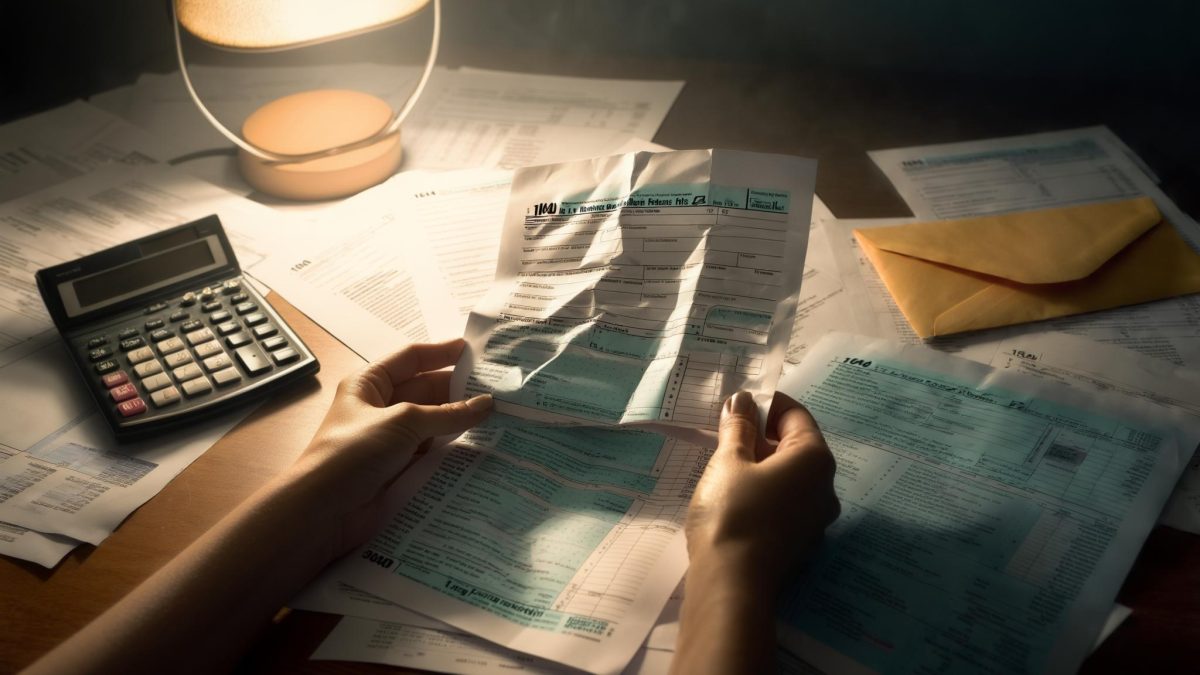
The IRS issued more than 93 million refunds in the 2025 filing season, according to agency data — and for most filers, those deposits arrived within 21 days of e-filing. For Dale Holloway, the math was supposed to work out the same way. He filed electronically on February 9, 2026. He expected roughly $2,400 back. Instead, he got a letter.
I learned about Dale through Karen Briggs, a branch manager at a credit union in southwest Atlanta. Dale had come in one Thursday afternoon asking about hardship loan options. Briggs told me afterward that she’d heard variations of his story more times than she could count — but something about Dale’s particular frustration stuck with her. “He’s someone who should understand this system better than most people,” she said. “That’s what made it so hard to watch.”
When I sat down with Dale Holloway at a diner near his apartment in East Point, he was 20 minutes early. He had a folder. He had printed out the IRS Where’s My Refund status page three times across three different weeks, each one showing a slightly different — and always vague — message. He slid the pages across the table before I’d even ordered coffee.
A Man Who Knows the Rules, Trapped by Them Anyway
Dale Holloway is 47 years old, divorced, and works as a senior accountant for a mid-size logistics firm in Atlanta. He has a graduate degree in accounting from Georgia State — a degree he’s still paying off, to the tune of $387 a month in federal student loan payments. He pays $650 a month in child support for his two kids, ages 12 and 15, who live with their mother in Marietta.
Despite his credentials and his job title, Dale describes himself as “broke in a way that doesn’t make sense on paper.” His take-home pay after taxes, child support withholding, and loan payments leaves him roughly $1,100 a month for rent, food, utilities, and everything else. His car — a 2014 Honda Accord with 194,000 miles — threw a check engine light in January and has been sitting in his parking lot since. He’s been taking the MARTA bus to work.
Dale had counted on his refund. Not for savings — he has none — but for the car repair estimate he’d gotten in late January: $1,850 for a cracked catalytic converter and two failing oxygen sensors. He’d mapped out exactly how the $2,400 would cover it, with a small cushion left over. “I had it budgeted down to the dollar,” he told me, his voice carrying a flatness that had clearly come from repetition. “I do this for a living. I budgeted it.”
The Letter That Changed Everything
On February 28, 2026 — nineteen days after he filed — Dale received a notice from the Bureau of the Fiscal Service, not the IRS itself. The letter explained that his refund had been intercepted under the Treasury Offset Program. Of his $2,400 refund, $2,147 had been applied to a past-due child support arrearage that had accumulated during a period in 2023 when his hours were cut and he missed three months of payments. The remaining $253 was deposited to his account.
Dale knew about the arrearage. He didn’t know it had been submitted to the TOP database. “I was paying it down,” he said. “I’d been making payments directly to the state disbursement unit since October. Nobody told me the amount had already been referred.” According to the Bureau of the Fiscal Service, state child support agencies can submit past-due balances to the TOP as long as the amount exceeds $150 for cases where the custodial parent receives public assistance, or $500 in other cases.
The arrearage on Dale’s account had been certified to the program in September 2025 — five months before he filed his return. He had no idea.
The Anger, and Where It Has Nowhere to Go
What struck me most about Dale Holloway was not his anger — though it was present, close to the surface, surfacing in the way he tapped his knuckles on the table when explaining things. It was the precision of his frustration. He wasn’t railing against child support as a concept. He wasn’t refusing accountability for the missed payments. He was angry at the architecture of a system that informed him of a consequence only after it had already happened.
Dale is not wrong that the notification timing is a problem many filers face. The pre-offset notice that the Bureau of the Fiscal Service is required to send goes to the address on file with the state child support agency — not necessarily the taxpayer’s current address. Dale had moved apartments in July 2025. The notice, he believes, went to his old address in College Park.
He tried calling the Georgia Division of Child Support Services three times in early March. The first call ended after 47 minutes on hold. The second reached an agent who confirmed the referral date but said the offset itself was now a federal matter. The third call resulted in a callback that never came. “It’s like trying to hold smoke,” he told me. “Everyone did their job correctly. And somehow I ended up with $253 and a broken car.”
What the Timeline Actually Looked Like
Where Things Stand — and What Didn’t Get Fixed
When I spoke with Dale in late March, he had not resolved the car situation. The credit union had offered him a personal loan at 18.9% APR — not a rate he could comfortably service on top of his existing obligations. He was weighing whether to take it anyway. “At some point you just have to move,” he said. “You can’t keep waiting for the system to notice you’re drowning.”
The $2,147 offset was applied correctly, as best as either of us could determine. The arrearage was legitimate. The certification process followed federal guidelines under HHS child support policy. Dale’s dispute isn’t that the debt doesn’t exist — it’s that the process offered him no real opportunity to prepare or respond before the money was already gone.
He does have one avenue remaining. Filers who believe an offset was applied in error — or who want to request an administrative review — can contact the agency that submitted the debt. In Dale’s case, that means Georgia child support services. A successful hardship review can, in some circumstances, result in a partial return of offset funds, though the bar is high and the process is slow. Dale said he plans to try, but his voice when he said it didn’t carry much expectation.
There’s also a broader number worth sitting with. According to the Bureau of the Fiscal Service, the Treasury Offset Program collected approximately $5.2 billion in delinquent child support through tax refund offsets in a recent fiscal year. That’s a program working exactly as designed. For the people on the receiving end of those intercepts — people like Dale, who are already operating with no margin — “working as designed” can feel like something far less neutral.
I left the diner before Dale did. He was still at the table when I looked back through the window — folder in front of him, coffee gone cold, looking at the printed Where’s My Refund pages one more time. There are millions of filers who check that tool every year hoping for good news. Dale already knew his answer. He was just still processing what it meant.




Leave a Reply