
Roughly 16 million self-employed Americans are responsible for paying their own federal taxes through quarterly estimated payments — and according to IRS guidance on estimated taxes, a significant share underpay at least once and face penalties as a result. What that statistic doesn’t capture is the specific human weight of receiving a bill you can’t pay, in a year when everything else is already falling apart.
I met Robert Kowalski on a Tuesday afternoon in late February 2026, inside the small waiting room of his auto shop on Milwaukee’s south side. He was wearing a gray work shirt with grease under his fingernails and a look that suggested he’d rather be under a car than talking to me. He agreed to the interview after a mutual contact made the introduction. He poured two cups of coffee, sat down across from me, and put a manila envelope on the table between us.
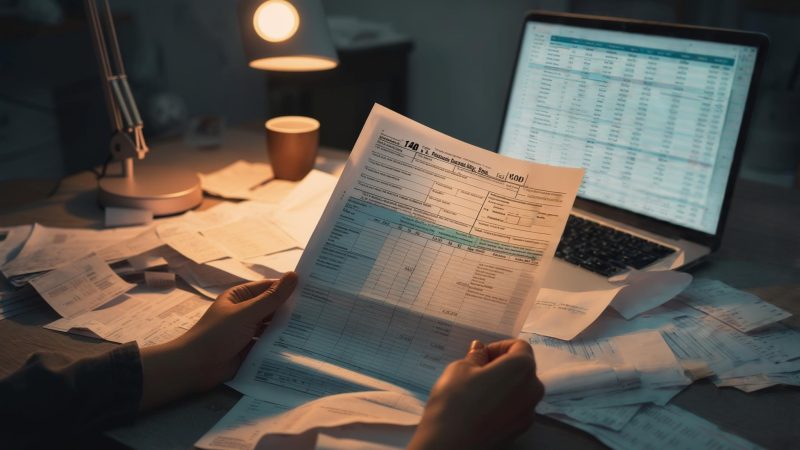
Inside was an IRS CP2000 notice — a balance-due letter showing he owed $6,200 in unpaid self-employment taxes plus interest for tax year 2024.
Eighteen Years, One Shop, and a Business Model That Stopped Working
Robert opened Kowalski Automotive in 2007 with a $22,000 equipment loan and a client base built mostly through word of mouth. For the first decade, the shop grossed between $160,000 and $190,000 annually. He employed two part-time mechanics, kept his overhead low, and felt reasonably secure. Then the cars changed.
Modern vehicles increasingly require proprietary dealer software to diagnose and reset fault codes — systems that independent shops either can’t access or would need to spend tens of thousands of dollars to replicate. Robert watched his diagnostic work dry up starting around 2021. By 2024, his gross revenue had fallen to approximately $126,000, down from a high of $180,000 three years earlier. That’s a 30% decline, or roughly $54,000 in lost annual revenue.
“I kept thinking it was temporary,” Robert told me, turning his coffee cup in his hands. “New cars, new problems, but eventually they all need brakes and suspension work, right? That part’s still true. But the diagnostic stuff — that’s where the margins were.”
As revenue fell, Robert made adjustments — cutting back part-time staff, delaying equipment upgrades, pulling from a small savings account he’d built over years. What he didn’t adjust was his quarterly estimated tax payments. In fact, he stopped making them entirely after the second quarter of 2023.
What Happens When You Stop Paying Quarterly Estimated Taxes
The IRS requires self-employed individuals to pay estimated taxes four times a year — typically on April 15, June 15, September 15, and January 15 of the following year. These payments cover both income tax and self-employment tax, which is calculated on Schedule SE (Form 1040). When those payments stop, the IRS doesn’t immediately call. The reckoning comes at filing time.
Robert filed his 2024 return in early March 2026 using a tax preparer he’d trusted for years. He expected to owe something — he knew he’d skipped payments — but not $6,200. The figure included approximately $4,800 in unpaid self-employment tax, $900 in federal income tax, and $500 in underpayment penalties and interest that had accumulated over 18 months.
“My preparer laid it all out and I just sat there,” Robert said. “I know what I spend on parts in a month. I know what my lift cost to repair. But taxes — I always just kind of handled it at the end of the year and hoped it worked out.”
That approach had worked, more or less, when his income was stable and predictable. A 30% revenue drop, combined with 18 months of skipped estimated payments, erased whatever buffer had existed before.
The IRS Installment Agreement Robert Didn’t Know He Could Request
When I asked Robert what his first instinct was after reading the CP2000 notice, he gave me an answer that surprised me with its directness.
His tax preparer, fortunately, pushed back. She explained that the IRS offers an Online Payment Agreement — a formal installment plan that allows qualifying taxpayers to pay their balance over time. According to IRS.gov’s payment agreement portal, taxpayers who owe $50,000 or less in combined tax, penalties, and interest may apply online without speaking to an agent.
Robert qualified. He applied in mid-March 2026 and was approved for a 72-month installment agreement at approximately $94 per month — with interest continuing to accrue on the unpaid balance at the current rate. It was not a resolution that made him happy. But it was a resolution.
The Bigger Problem Nobody at the IRS Can Solve
The installment agreement settled the immediate crisis. What it didn’t address was everything surrounding it. Robert’s son, Marcus, 18, was accepted to a university in Minnesota with a sticker price of $45,000 per year. Robert and his wife, who works as a school administrator, had hoped to help him — not fully, but meaningfully. That conversation, Robert told me, had recently become very difficult.
“He got in. That’s great. That’s what you want for your kid,” Robert said. “But I’m sitting here with a payment plan with the IRS, zero retirement savings at 52, and my wife’s salary is basically what keeps the lights on at home. What am I supposed to tell him?”
Self-employed workers without access to employer-sponsored retirement plans have options — SEP-IRAs, Solo 401(k)s, SIMPLE IRAs — but Robert had never set one up. He described financial planning as something he’d always meant to get to. At 52, with a declining business and a fresh IRS debt, the gap between intention and action felt very wide.
I didn’t push back on that. He wasn’t wrong that small-business ownership is consuming. He was, however, describing a pattern — deferred taxes, deferred savings, deferred conversations — that had compounded quietly into something that couldn’t be deferred any further.
Where Robert Stands Now, in His Own Words
When I wrapped up my time with Robert, the shop was getting busy again — a pickup truck had come in for a transmission issue, the kind of job that doesn’t require dealer software. He seemed to brighten slightly walking back toward the bays. The IRS plan was in place. His son was exploring in-state options and scholarship applications. His wife had recently picked up a second part-time role.
None of that is a solution. It’s a holding pattern, and Robert knows it. His tone when we said goodbye was less defeated than I’d expected, but more tired than relieved.
The IRS installment agreement gives him until roughly 2032 to clear the 2024 debt — assuming no new balances accumulate. His 2025 return is already on his mind. His preparer has set up a reminder system for quarterly payments going forward: April 15, June 16, September 15, and January 15, 2027. He’s agreed to actually make them this time.
What Robert’s story reflects isn’t unusual. Millions of self-employed Americans navigate the same structure — responsible for their own withholding, their own retirement, their own safety net — with no employer to automate any of it. When income is stable, the system is manageable. When income drops 30% over three years and no adjustments are made, the bill eventually arrives.
His arrived in a manila envelope on a Tuesday in February. He put it on the table and showed it to a reporter. That, at least, was a start.
Related: She Left Her Corporate Job to Teach Yoga — Then Realized Her Family Had No Safety Net at All



Leave a Reply