
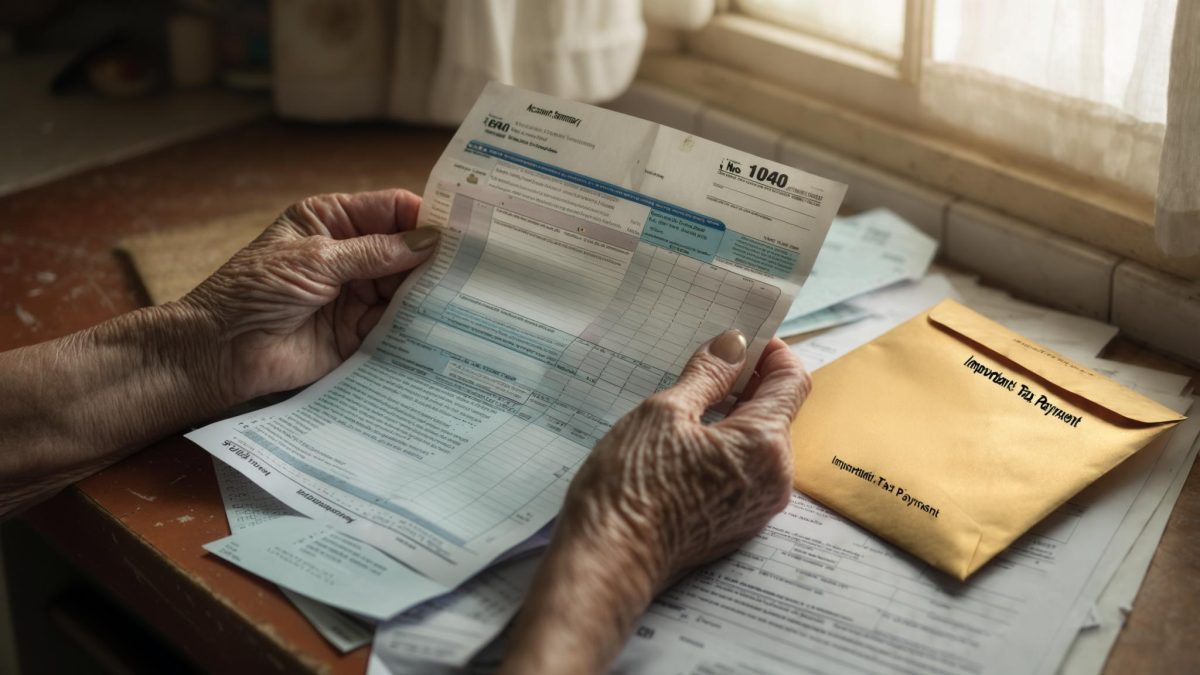
The first week of April is when many Americans realize their refund is not coming as fast as the IRS’s “Where’s My Refund” tool implied. For freelancers, the math is often especially tight — quarterly estimated taxes, inconsistent income, and a family budget that depends on a refund arriving before the spring property tax deadline. That window, for many households, is already closed for 2026.
I was introduced to Nolan Uribe in mid-March by Pastor Devin Holloway at Cornerstone Community Church in Omaha, Nebraska. Pastor Holloway had mentioned, carefully and without specifics, that one of his congregants — a self-employed designer with three kids — had been quietly struggling through a situation that started with a tax refund and ended somewhere much harder. When I reached out, Nolan agreed to talk. We met at a coffee shop on Dodge Street on a Thursday afternoon, and he arrived with a manila folder of IRS notices and a look that was equal parts relief and exhaustion.
The Numbers Nolan Was Carrying Into Tax Season
Nolan Uribe, 47, has worked as a freelance graphic designer for nearly a decade. His clients include regional ad agencies, a national nonprofit, and several small businesses across the Midwest. His income is real — in 2025, he brought in roughly $118,000 in gross freelance revenue — but so are the complications that come with self-employment. Quarterly estimated taxes, no employer withholding, and a year that included a medical emergency that blew a hole in his finances.
In the spring of 2025, his youngest daughter required emergency surgery. The procedure was covered partially by insurance, but the out-of-pocket costs — copays, follow-up appointments, and a specialist bill that arrived four months later — totaled approximately $8,700. Most of it went on a credit card. By the time he sat down to file his 2025 taxes in February 2026, that balance had grown to just over $9,200 with interest.
On top of the credit card balance, Nolan was two quarters behind on his Douglas County property taxes — a total of $3,400 due, with a penalty clock already running. His wife, Melissa, stays home with their three children, ages 8, 12, and 15. There is no secondary income. When Nolan filed his 2025 federal return on February 7, 2026, he was counting on a refund of approximately $5,200 to address at least the property tax bill and make a meaningful dent in the card balance.
“I know the math doesn’t fully work,” he told me, smoothing the corner of a document in his folder. “But if I could just get the property taxes current, I could breathe again. That was the whole plan going into filing season.”
When the IRS Goes Silent: The Identity Verification Hold
For the first 21 days after filing electronically, Nolan checked the IRS Where’s My Refund tool daily. The status read “Return Received” and then, on day 11, it shifted to “Return Being Processed.” That message stayed frozen for weeks. No movement. No deposit. No letter.
According to the IRS, most electronically filed returns with direct deposit are processed within 21 days. When a return is flagged — for identity verification, income discrepancy, or other review triggers — that timeline extends significantly, sometimes into 60 to 120 days, and the agency does not always send immediate written notice.
On day 34, Nolan finally received a letter — IRS Notice CP05 — dated February 28. The notice informed him that the IRS was reviewing his return and needed additional time to verify income and withholding information. No action was required from him at that point. The letter stated the IRS expected to complete its review within 60 days of the notice date, which put a potential resolution date at late April 2026.
“That letter felt like a door closing,” Nolan said. “I called the IRS number on the notice and waited 2 hours and 20 minutes to speak to someone. They told me exactly what the letter said. Nothing more.”
The Property Tax Clock and a Decision He Still Questions
With the refund frozen and no clear end date in sight, Nolan faced a decision in early March. Douglas County’s delinquent property tax penalties in Nebraska accrue at a rate that compounds the longer the debt sits unpaid. His $3,400 balance was already carrying a penalty, and the county’s annual tax sale — at which delinquent properties are listed for lien certificates — was a future risk he didn’t want to test.
He paid the county on March 9. That left his business account with $200 and no buffer for the quarterly estimated tax payment due April 15, 2026. The credit card debt remained untouched. Nolan described that week as the lowest point in a stretch that had already been difficult. “I’ve worked for myself for nine years,” he said. “I’ve never felt as exposed as I did in March.”
The Refund Arrives — and What It Actually Covered
On April 1, 2026 — 61 days after he filed — Nolan’s direct deposit arrived. The amount: $4,823. The IRS had adjusted his return slightly downward from his expected $5,200, reducing his refund by $377. When I asked if he’d received an explanation for the adjustment, he pulled out a CP21B notice, which indicates a change was made and a refund issued. The notice referenced a recalculation of his Schedule SE self-employment tax, though Nolan said the specifics remained unclear to him even after reading it twice.
The deposit did not go toward the property taxes he had already paid. Instead, Nolan made a $4,000 payment against the credit card balance, bringing it from $9,200 down to approximately $5,200. The remaining $823 went back into the business account to partially rebuild his emergency buffer. “It wasn’t the plan I had in February,” he told me. “But it’s something.”
He said the word “something” with a kind of careful precision — not satisfaction, exactly, but acknowledgment. He is still carrying more than $5,000 in high-interest credit card debt. He has no retirement savings. The April 15 estimated tax deadline is two weeks away and he isn’t sure he can fully cover it. The small win he experienced on April 1 was real, but Nolan is acutely aware that the structural problems that preceded it haven’t been resolved.
What the Wait Actually Cost — Beyond the Dollars
When I asked Nolan what he wished he had known going into this year’s filing season, he didn’t talk about tax strategy. He talked about preparation for delay. “I’ve always assumed the refund would come in three weeks like everyone says,” he told me. “I built my entire spring plan around that assumption. That was the mistake.”
For self-employed filers, the risk of a CP05 review is statistically higher, in part because income verification for freelancers involves cross-referencing 1099-NEC forms from multiple payers — a process the IRS identity theft and review procedures treat with additional scrutiny. Nolan received 1099s from seven different clients in 2025. He said he triple-checked every number before filing. The hold, as far as he can tell, was not the result of any error on his part.
According to the Taxpayer Advocate Service, processing delays disproportionately affect self-employed filers and those with complex returns. The agency handled over 167 million individual returns in the most recent fiscal year, and a subset of those — particularly those involving identity verification flags — can sit in review for weeks or months without automatic updates to the taxpayer.
He is not angry at the IRS, he was careful to say. Frustrated, yes. But he understands that the verification process exists for legitimate reasons, and that his return — seven 1099s, a home office deduction, Schedule SE, and a Qualified Business Income deduction — is not a simple one. What stings is the timing, and the silence during the wait.
When I left the coffee shop that Thursday, Nolan walked out with his manila folder tucked under his arm. He mentioned, almost as an afterthought, that he still has no retirement savings — not a dollar in an IRA or any other account. At 47, with three kids and a spouse at home and a credit card that took a medical hit last spring, that fact is the one that seems to weigh on him most quietly. The refund came. The immediate crisis eased. But the longer horizon is still uncharted, and Nolan knows it.
“I’m grateful,” he said, standing near his car. “I’m genuinely grateful. I just don’t know how long grateful is going to be enough.”


Leave a Reply