
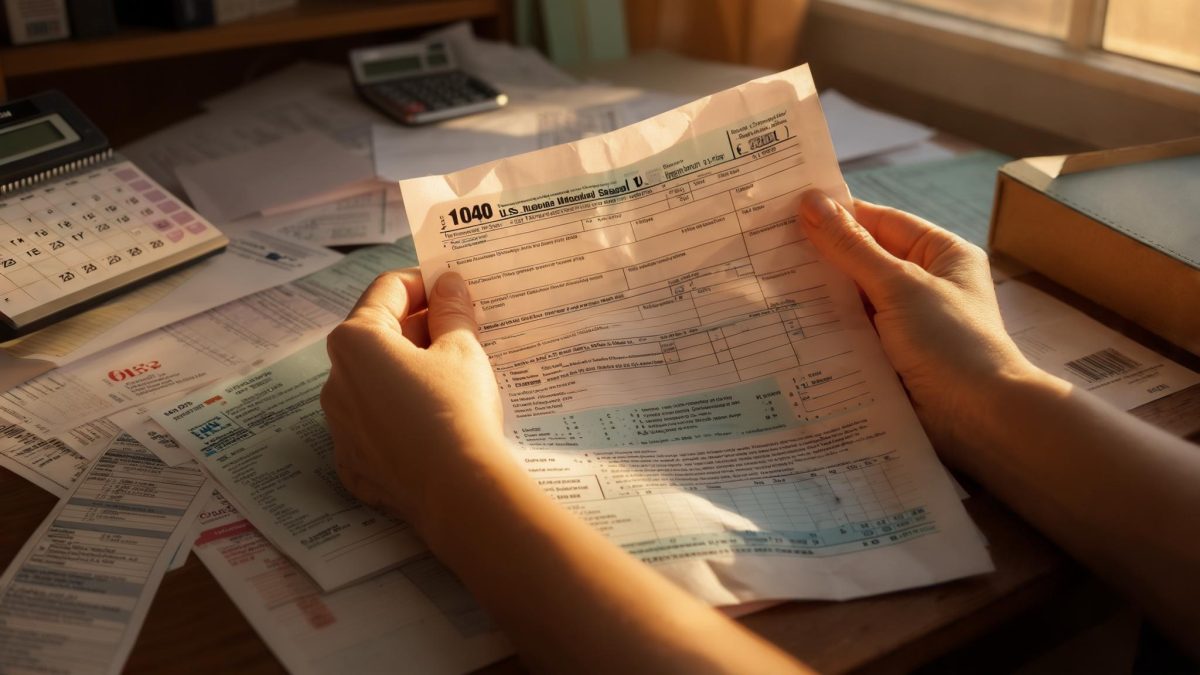
The conventional wisdom says that self-employed filers who submit early in February are rewarded with faster refunds. For Tommy Yarbrough, that advice aged poorly. When I sat down with him in mid-March 2026 at a folding table near the back of the Louisville Free Public Library, he hadn’t seen a cent of his $1,380 federal refund — filed six weeks prior — and he was not surprised.
Tommy had approached me near the end of a Medicare open enrollment information session I was covering for Check Day America. He’d overheard me asking an IRS Volunteer Income Tax Assistance coordinator about processing timelines for Schedule C filers. He waited until the coordinator walked away, then said, quietly: “You covering that? Because I got a story for you.”
A Year That Kept Taking
Before we talked about the refund, Tommy filled me in on the 14 months that preceded it. In January 2025, he slipped on a wet floor at his barbershop — his own shop, which he’s operated solo on Bardstown Road since 2019 — and tore a ligament in his right wrist. The injury was real, the medical bills were real, and the workers’ compensation claim he filed was denied three months later on the grounds that, as a sole proprietor, he had not carried the required coverage on himself.
The denial letter arrived in April 2025. Out-of-pocket medical costs for the wrist came to roughly $4,200. He paid most of it on a credit card at 24.9% APR. He was still carrying about $2,800 of that balance when we spoke.
Then came the property insurance. In August 2025, after Tommy filed a claim for water damage caused by a burst pipe in the shop’s back room — repairs that cost $6,100, of which insurance covered $3,800 — his insurer sent a non-renewal notice. The policy expired in October 2025. He had not found a replacement carrier as of our conversation. “I’ve called five companies,” he told me. “Either they don’t write policies for barbershops that had a claim, or the premiums are so high I’d rather take the risk.”
He is also carrying approximately $34,000 in student loan debt from a master’s degree in business administration he completed in 2018 — a credential he pursued with the intention of eventually franchising. That plan, he said flatly, “didn’t happen.”
The Tax Return That Should Have Been Simple
Tommy filed his 2025 federal return on February 7, 2026, using a paid preparer who charges him $185 each year. He files as a sole proprietor on Schedule C, reporting his barbershop income. His gross receipts for 2025 came in at roughly $61,400 — lower than his typical year, in part because the wrist injury kept him out of the chair for about six weeks in the spring.
After accounting for self-employment tax, his estimated quarterly payments — which he’d made consistently throughout 2025 — and a deduction for his health insurance premiums, his preparer landed on a $1,380 federal refund. His Kentucky state return produced a separate refund of $214, which arrived in his bank account within nine days. The federal refund did not move.
According to IRS Where’s My Refund, the standard processing window for electronically filed returns is 21 days for most filers. Schedule C returns — which report self-employment income and are subject to higher scrutiny for claimed deductions — can take longer, particularly when the IRS flags a return for manual review. Tommy’s return had been sitting on “Return Received” status for weeks before finally moving to “Refund Approved” in early March. But approved, as many filers discover, is not the same as deposited.
What the IRS Portal Actually Told Him
Tommy checked Where’s My Refund almost every morning. He described this ritual without drama — it was just something he did before opening the shop, like checking his phone for appointment cancellations. “It said approved for two and a half weeks before it gave me a deposit date,” he told me. “Then the deposit date came and went and nothing showed up.”
The date the portal had displayed was March 12. On March 13, Tommy called the IRS helpline — 1-800-829-1040 — and waited on hold for approximately 55 minutes before reaching an agent. The agent confirmed the refund had been approved and reissued a direct deposit trace number, telling him to allow an additional five to ten business days.
This situation — a refund approved by the IRS but not received by the taxpayer — is more common than most people assume. According to the IRS Taxpayer Advocate Service, processing and payment bottlenecks disproportionately affect self-employed filers whose returns include Schedule C, Schedule SE, and adjustments for health insurance deductions — exactly the profile of Tommy’s return.
The Refund Arrives — 73 Days Late
I followed up with Tommy by phone on March 21, 2026. He told me the $1,380 had finally deposited that morning — 42 days after the original 21-day window had elapsed, and 10 days after the IRS agent told him to wait five to ten business days. He found out when his bank app sent him a notification while he was in the middle of a fade cut.
He used $800 of it immediately to reduce the credit card balance carrying the medical debt from the workers’ comp injury. The remaining $580 went into his checking account as a cushion against the uninsured property risk at the shop — a contingency fund for a problem that insurance is supposed to solve.
“It’s not life-changing money,” Tommy said when we spoke after the deposit. “But it was my money. I overpaid them. I just wanted what I was owed.” He paused. “I guess I got it. Eventually.”
The Cost of Going Through the Motions
What struck me most about Tommy Yarbrough wasn’t the amount of money involved or the bureaucratic obstacles — it was his affect throughout. He described a denied workers’ comp claim, a dropped insurance policy, $34,000 in student debt, and a 73-day tax refund delay with the same flat, unhurried tone he might use to describe a slow Tuesday at the shop. He wasn’t performing resilience. He had simply run out of the energy required to be shocked.
For self-employed workers in Tommy’s income bracket — gross receipts just above $60,000, with significant deductible expenses and self-employment tax obligations — the federal tax refund is not a windfall. It is a correction. It represents money that was withheld or overpaid across four quarterly estimates, returning now, months later, without interest. The IRS does not pay interest on refunds issued within 45 days of the filing deadline — a detail that benefits no one except the Treasury.
Tommy’s 2026 tax year is already in motion. He’s making quarterly estimated payments again, starting with a $780 payment he submitted in mid-January. If his income holds and his deductions remain consistent, he expects a similar refund next spring. He plans to file on the same day as this year — February 7.
When I asked him if he’d do anything differently, he thought about it for a moment. “File earlier, maybe,” he said. Then: “No. Wouldn’t have mattered.”
He’s probably right.
Related: My Workers’ Comp Claim Was Denied — Now a Debt Collector Is Taking 25% of My Freelance Income



Leave a Reply