
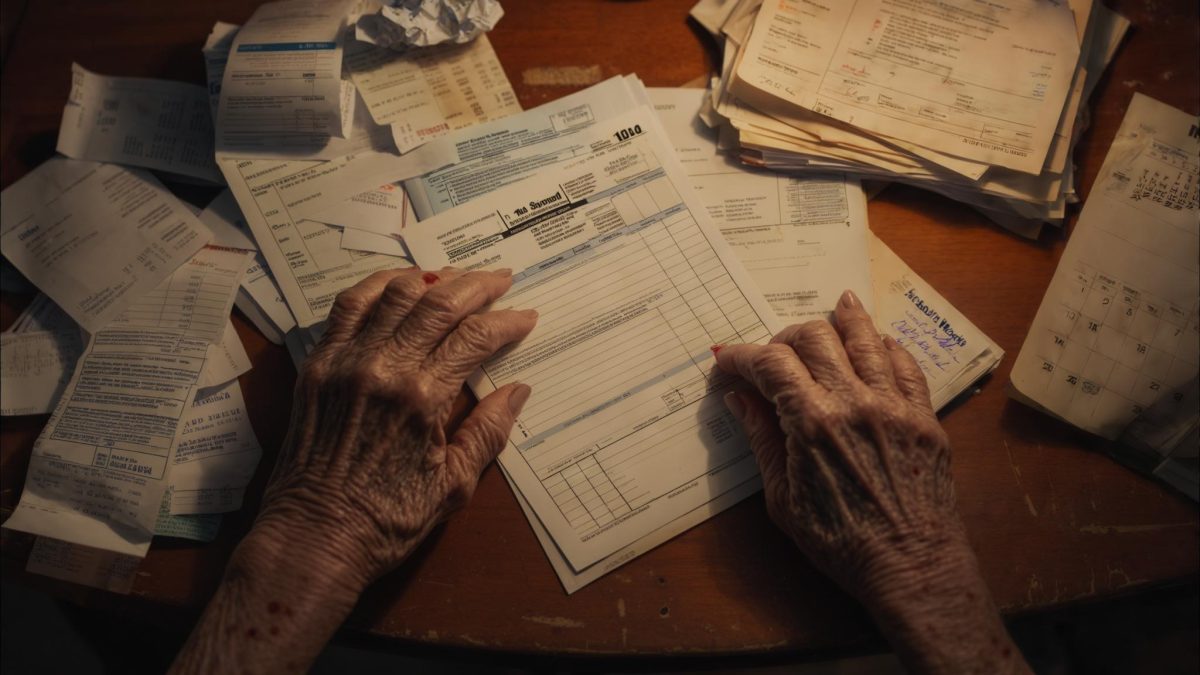
Steady employment is supposed to be the foundation of financial security. That’s the story most of us were told. But when I sat down with Monique Washington, 43, in the dining room of her Baltimore rowhouse on a Tuesday morning in late February 2026, I realized that story has a quiet asterisk for millions of Americans — one the tax code barely acknowledges and the public rarely sees.
Monique drives for UPS. She has for seventeen years. She earns solid union wages, carries health insurance, and accrues pension credits every quarter. By almost every standard metric, she is financially stable. And yet, by the time I visited, she had not taken a real vacation in six years, had contributed zero dollars to her own retirement account in roughly the same stretch, and was quietly rationing how often she refilled her brother DeShawn’s compression supplies — items Medicaid classifies as non-essential.
How a Car Accident at 25 Reshaped One Family’s Entire Financial Architecture
DeShawn Washington was 25 when another driver ran a red light and struck him on I-695 outside Baltimore. That was eighteen years ago. The accident left him with a traumatic brain injury and significant physical limitations that require daily assistance — help with mobility, medication management, and cognitive tasks that most adults handle without thinking.
Their parents managed most of the caregiving for the first several years. Then their father died in 2016, and their mother two years later. Monique, the only sibling, stepped in completely. She restructured her UPS shift to days so she could be home by 5 p.m. She converted the back bedroom. She hired a part-time aide for the hours she’s on her route — out of pocket, because Medicaid’s home care hours don’t stretch far enough.
DeShawn receives Social Security Disability Insurance. According to the Social Security Administration, the average SSDI monthly benefit as of early 2026 is approximately $1,542. DeShawn’s benefit is close to that figure. It covers his portion of the mortgage, his food, and a portion of his prescriptions. The rest falls to Monique.
“I sat down with a notebook one January and tracked everything for twelve months,” Monique told me. “Transportation to his appointments, the aide’s hours Medicaid won’t pay, the medical supplies, the wheelchair van rental when his chair needs servicing. At the end of the year it was just under fourteen thousand dollars. I almost didn’t want to add it up.”
What the Tax Refund Actually Means in Monique’s House
For many workers, a federal tax refund is an annual bonus — a lump sum to book a trip, pay down a credit card, or throw into savings. For Monique, the refund is closer to what she calls a “reset button.” It covers a portion of what she’s spent on DeShawn’s care throughout the year, essentially returning money she’s already paid out.
In tax year 2025, Monique filed as Head of Household, which reduced her taxable income and shifted her into a lower bracket compared to Single filer status. She claimed DeShawn as a qualifying relative dependent — a designation that requires meeting specific IRS income and support tests outlined in IRS Publication 501. Because DeShawn’s gross income falls below the 2025 threshold of $5,050, and Monique provides more than half his total support, he qualifies.
She also claimed the Credit for Other Dependents — a nonrefundable credit worth up to $500 per qualifying dependent. It’s not a large credit, but Monique told me she’ll take everything that’s legally available to her. Her 2025 federal refund came to approximately $2,840, deposited via direct deposit on March 4, 2026 — eleven days after she filed electronically in late February.
The Year the IRS Flagged Her Return — and What It Cost Her
Not every filing cycle has gone smoothly. Monique described tax year 2022 as the most stressful interaction she’d had with the IRS in her adult life. She had switched tax preparers that year — a decision she now regrets — and the new preparer entered DeShawn’s Social Security number incorrectly on the dependent line.
The IRS flagged the mismatch during processing. Her return was placed in manual review. According to the IRS refund FAQ, returns that require manual review can take significantly longer than the standard 21-day window — in some cases eight to twelve weeks. Monique’s 2022 refund, which she’d been counting on to cover a $1,200 balance on DeShawn’s accessible van repair, didn’t arrive until late May of that year.
“I was on hold with the IRS on my lunch break, sitting in my truck, eating a sandwich,” she said. “Two hours and fourteen minutes. I know because I watched the clock. And at the end of it, the agent was actually nice. That almost made it worse — like, this wasn’t her fault either.”
The experience pushed Monique back to her original preparer, a woman named Carol who has handled Baltimore-area union workers’ returns for over twenty years. Carol charges $185 for Monique’s return. Monique considers it one of her better annual expenditures.
The Retirement Question She Doesn’t Let Herself Think About Too Long
When I asked Monique about her own retirement savings, she went quiet for a moment. Not the silence of someone who doesn’t have an answer — more like someone who has rehearsed not thinking about it too carefully.
She last contributed to her UPS pension through the Teamsters plan in 2019. She has not made contributions to a personal IRA or 401(k)-style account since approximately the same period. At 43, she’s aware that the window for compounding growth is narrowing. She said it plainly, without drama: “I know what I’m giving up. I just don’t have another option right now.”
The resentment she describes is quiet and complicated. She doesn’t resent DeShawn. She resents the system that calculates disability benefits against a cost-of-living that hasn’t matched reality in years, that defines “covered care” in ways that leave real gaps, and that offers caregivers like her a $500 nonrefundable credit while she absorbs $14,000 in annual costs without blinking.
What the 2025 Filing Season Looked Like — and What Monique Is Watching in 2026
Monique filed her 2025 return on February 19, 2026. She filed electronically through Carol’s office and selected direct deposit to her checking account. Using the IRS “Where’s My Refund” tool, she tracked the status daily — a habit she developed after the 2022 delay. Her return moved to “Refund Approved” status on February 28, and the $2,840 deposit arrived March 4.
She used $1,100 of it immediately to replenish DeShawn’s supply of adaptive equipment that she’d deferred purchasing through the winter. Another $900 went to a past-due balance on the aide’s contract — she’d been paying the aide in partial installments since October. The remaining approximately $840 sits in her checking account, which she described as “not savings, just a buffer.”
For 2026, Monique is watching two things closely. The first is whether Maryland’s Medicaid waiver program will expand covered home aide hours — a proposal that has been in committee for over a year. The second is whether any federal caregiver credit legislation advances, something advocacy organizations have pushed for repeatedly but which has stalled in Congress multiple times.
She is not optimistic about either. “I’ve learned not to count on things that aren’t in my account yet,” she said. There was no bitterness in how she said it. Just seventeen years of calibrated expectations.
What Monique’s Story Reveals About the Gap Between Stability and Security
When I left Monique’s house that Tuesday morning, she was already in her UPS uniform. DeShawn’s aide, a woman named Patricia, was arriving as I walked to my car. Monique gave Patricia a list of appointments, checked in with DeShawn briefly, and headed out the door to start a ten-hour route.
She earns good wages. She has insurance. She has a pension — though it’s been dormant for six years. By the numbers that most financial narratives use, she’s doing fine. But the tax code, the disability benefit structure, and the caregiving economy have collectively created a situation where a hardworking, responsible adult is slowly depleting the financial runway she’ll need in twenty years.
Her annual refund of roughly $2,800 is not a windfall. It’s a partial reimbursement for labor and costs the government doesn’t fully see. The IRS forms capture some of it — the Head of Household status, the dependent credit, the deductions Carol identifies. They don’t capture the two-hour hold times, the rationed compression supplies, or the vacations that haven’t happened since 2019.
Monique Washington isn’t asking for sympathy. She made that clear before I turned on my recorder. She’s asking, in her own measured way, that the systems surrounding people like her start doing the math more honestly.




Leave a Reply