

Roughly 1 in 4 self-employed filers received a smaller-than-expected federal tax refund in early 2026, according to estimates from tax professionals tracking the season — a pattern that is landing hardest on sole proprietors whose income arrives in cash and tips rather than a neat weekly paycheck.
I met Sheila Dillard on a Tuesday afternoon in late March at a Shell station off Brookshire Freeway in Charlotte, North Carolina. I was at the pump when I noticed the woman behind me — close-cropped natural hair, a black smock still dusted with hair clippings — speaking quietly but urgently into her phone. “I just don’t understand how we ended up with almost nothing,” she said, her voice dropping on the last word. “We did everything right.”
I introduced myself after she hung up. She looked tired in a specific way — not sleepy, but worn — and smiled the kind of smile people use when they’ve been carrying something heavy for too long. She agreed to talk.
Eleven Years in Business, and the Math Is Getting Harder
Sheila Dillard is 50 years old and has owned Cuts by Sheila, her barbershop in Charlotte’s Westover Hills neighborhood, for nearly eleven years. Her husband Marcus, 54, spent 28 years as a warehouse supervisor before retiring last October. They’ve been married since 1998. Their youngest child moved into her own apartment in August 2025, officially making them empty nesters — though, as Sheila was quick to point out, that label doesn’t mean empty expenses.
“Our daughter Kezia has a two-year-old,” Sheila told me, sitting on the hood of her car after we’d both finished pumping gas. “She went back to work and we’ve been helping her cover daycare. It’s $680 a month. We don’t complain about it — that’s our grandchild — but it adds up fast when other things are going up at the same time.”
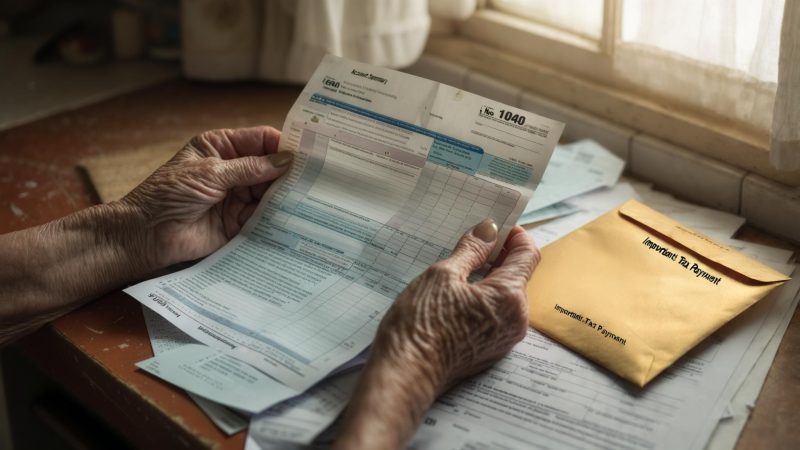
The barbershop cleared roughly $41,000 in gross revenue in 2025. After Schedule C deductions — supplies, chair rental offsets, a portion of her phone — her net self-employment income came to approximately $29,500. Marcus’s pension kicked in with partial-year distributions beginning in October, adding around $9,200 to their joint household income before the year closed.
Sheila had been counting on a refund of around $2,600 — enough to cover a $1,200 repair bill on two barber chairs with squeaking hydraulics and pay down a credit card balance she’d been carrying since December. On March 14th, the IRS deposited $940 into their joint checking account.
When the Insurance Bill Changed Everything
Of all the pressures Sheila described, the health insurance situation was the one that reconfigured her entire year before it even started. Because Marcus retired at 54 — well before Medicare eligibility at 65 — both he and Sheila are currently enrolled in a marketplace plan through the ACA exchange. Their monthly premium in 2024 was $487. In January 2025, the renewal letter arrived with a new figure: $934 per month.
“I’m not exaggerating when I say I cried when I opened that letter,” Sheila told me. “We’d built our whole budget around that old number. Almost five hundred dollars extra every month — that’s real money when you’re running a small shop.”
The annual insurance cost jumped from $5,844 to $11,208 — a $5,364 increase in a single calendar year, on a household whose total income simultaneously dropped because of Marcus’s retirement. Sheila said she knew the self-employed health insurance deduction would help on her federal return, and it did reduce her adjusted gross income. But the deduction softened the tax impact; it did not restore the cash.
A Missed Payment and a Cascading Shortfall
The gap between $2,600 and $940 has more than one explanation, and Sheila walked me through all of them with the calm precision of someone who has already spent weeks replaying the same sequence.
As a self-employed shop owner, Sheila is required to make quarterly estimated tax payments to the IRS — typically in April, June, September, and January. She told me that in 2024, she missed her Q3 payment entirely after a burst pipe behind her shampoo bowls cost her $1,900 in emergency repairs during the same week the payment was due. “I told myself I’d make it up in Q4,” she said. “And I mostly did. But not completely.”
The partial under-withholding — approximately $680 by her estimate — compounded when Marcus’s pension distributions began in October without an adjusted withholding election in place. Pension income can be withheld using a W-4P form, but Marcus had not filed one before his first distribution arrived. The result was that three months of pension income entered their joint return with no federal tax withheld.
According to CNBC’s reporting on 2026 refund shortfalls, taxpayers with mixed income sources — combining self-employment with a spouse’s retirement or pension income — are among those most likely to see refunds fall short this season. Withholding on pension distributions is frequently miscalculated when it sits alongside Schedule C income in the same household return.
A Pattern Larger Than One Barbershop
Sheila’s experience belongs to a wider story unfolding across the 2026 filing season. Despite White House projections of “very large” refunds for taxpayers this year, as USA Today reported in late March
, many Americans are finding their refunds materially below expectations. The average refund has increased by far less than officials projected, and for lower-income households, the picture is often worse.
Part of the explanation is structural. As The Hill has noted, more tax relief in recent years has been delivered upfront through adjusted withholding tables rather than as a lump-sum check at filing time. The money arrives incrementally across 52 weekly paychecks rather than in one visible deposit in March. For salaried workers, that shift is invisible. For self-employed filers like Sheila, there are no weekly paychecks to adjust.
The breakdown of Sheila’s tax year illustrates how quickly multiple pressures can converge on a single return:
What Happens After the Number Lands
When Sheila saw the $940 deposit notification on her phone on the morning of March 14th, she was standing in her kitchen while Marcus watched television in the next room. “I didn’t say anything,” she told me. “I just stood there staring at it for a minute. Then I put the phone in my pocket and went and made coffee.”
The barber chair repairs are on hold. The $1,200 estimate from a salon equipment company in Gastonia is sitting on her desk, and she now plans to split the cost across two credit cards over the next two months. The $680 monthly contribution toward Kezia’s daycare has prompted a harder conversation — Sheila said she and Marcus have told their daughter they’ll need to taper the support by summer.
Marcus has since looked into filing a W-4P form to elect federal withholding on his 2026 pension distributions — something their tax preparer recommended after reviewing the return. For the current year, Sheila says she has already set aside her Q1 estimated payment, due April 15th, and has posted a reminder on her bathroom mirror for Q2.
The adjustments are sensible. But Sheila was clear-eyed about what they represent: catching up, not getting ahead.
My clients come in and they’re talking about their refunds — what they’re going to do with the money, maybe a vacation, maybe new furniture,” she said. “And I just listen and cut and smile. I don’t say a word about mine.”
That image stayed with me after I drove away from the gas station: Sheila standing behind someone, scissors moving, listening to their good news with a composed face. Eleven years in business. Twenty-eight years of marriage. A grandchild she helps support because that’s what family does. And a $940 deposit where $2,600 was supposed to be.
She texted me two weeks after we spoke: “Both chairs still squeaking. But we’re fine.”
I believe she meant it, at least partly. That’s the bravest kind of fine there is.
Related: He Worked 32 Years at UPS and His Benefits Still Leave Him $620 Short Every Month


Leave a Reply