
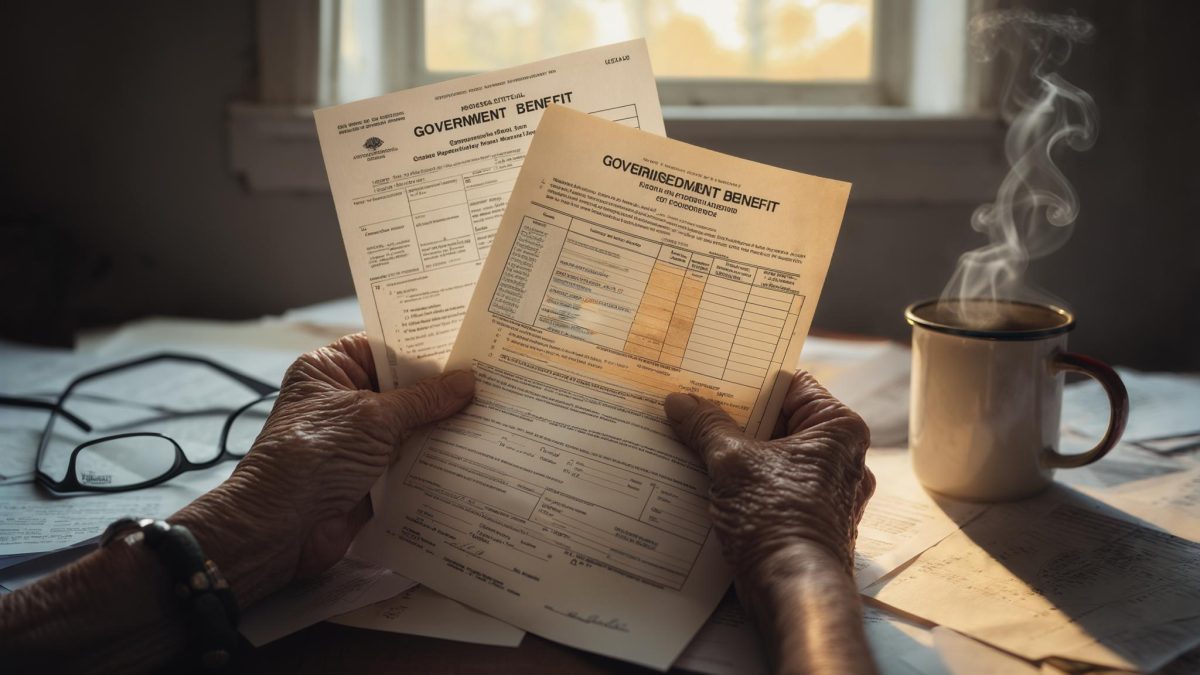
The window for correcting a Social Security benefit calculation error is not unlimited. According to SSA’s survivor benefits guidance, beneficiaries who believe their payment is incorrect should file a formal request for reconsideration within 60 days of receiving a determination notice — a deadline that, as I learned from one Pittsburgh retiree, is easy to miss when grief is doing the thinking for you.
When I sat down with Patricia Novak at her kitchen table in Pittsburgh’s Beechview neighborhood last month, she had a folder thick with SSA correspondence, IRS notices, and handwritten budget sheets going back to 2023. She is 65 years old, retired after 32 years with the United States Postal Service, and she is quietly furious — not in a loud way, but in the way of someone who has been careful her entire life and still ended up short.
The Numbers That Stopped Making Sense
Patricia’s husband, Gerald, died in early 2023. He had collected Social Security retirement benefits of approximately $1,640 per month. Under federal survivor benefit rules, Patricia was entitled to receive the higher of her own benefit or up to 100 percent of Gerald’s benefit — whichever was greater. Her own Social Security benefit, based on her USPS career, was roughly $1,290 per month.
The math should have been straightforward. But when her first survivor benefit payment arrived in the spring of 2023, it was $1,328 per month — not the $1,640 she expected. The SSA had applied a reduction she didn’t understand, and the letter explaining it was written in language she described as “like reading a different language.”
“I thought maybe I was wrong,” Patricia told me, smoothing the edge of a document with her thumb. “I figured they had people who knew what they were doing. I didn’t want to be the person who makes a fuss.” That instinct — to defer, to trust the system — cost her eleven months of underpayment before a benefits counselor at a local senior center flagged the discrepancy in February 2024.
The IRS Notice That Arrived in the Middle of Everything
Compounding the Social Security confusion, Patricia received an IRS CP2000 notice in the fall of 2023 — a document the IRS describes as an automated mismatch notice, not an audit, but one that proposes additional tax owed based on income reported by third parties that doesn’t match a filed return.
The notice proposed she owed $847 in additional federal tax. The source of the mismatch: a small 1099-R distribution from a USPS pension account she had partially cashed out during Gerald’s illness to cover his medical bills. She had reported the income but had not correctly accounted for the taxable portion after the partial rollover.
Patricia told me she put the notice in a drawer for three weeks. “I was dealing with the Social Security thing, I was dealing with the roof estimate — I just couldn’t look at it,” she said. When she finally called the IRS helpline, she waited on hold for 47 minutes before reaching an agent. The agent confirmed the proposed amount but told her she could dispute it with documentation of the rollover.
What the Benefit Counselor Found — and What It Took to Fix It
The turning point came in February 2024, when Patricia visited the Allegheny County Area Agency on Aging for an unrelated question about prescription drug costs. A benefits counselor there reviewed her SSA award letter and identified the problem within twenty minutes: the SSA had applied a Government Pension Offset (GPO) reduction to her survivor benefit, reducing it by two-thirds of her USPS pension amount.
The GPO is a federal provision that reduces Social Security spousal and survivor benefits for people who also receive a pension from work not covered by Social Security taxes. However, USPS employees hired before 1984 were covered under the Civil Service Retirement System (CSRS), which did not withhold Social Security taxes — making them subject to GPO. Patricia’s situation was borderline: she had switched to the Federal Employees Retirement System (FERS) partway through her career, which does withhold Social Security taxes, and the SSA had applied the offset incorrectly to her full pension amount rather than only the CSRS portion.
The counselor helped Patricia file a formal reconsideration request with the SSA in March 2024. The process required gathering her complete employment history, CSRS and FERS enrollment dates, and pension award documentation — paperwork that took roughly six weeks to compile. The SSA acknowledged receipt but provided no timeline for resolution.
The Outcome — and What It Couldn’t Fix
In September 2024, roughly eighteen months after Gerald’s death, the SSA issued Patricia a corrected award letter. Her monthly benefit was adjusted to $1,640, and she received a lump-sum back payment of approximately $3,520 — slightly less than the full underpayment because of how the SSA calculated the correction window from the reconsideration filing date rather than the original award date.
The IRS matter was resolved separately. Patricia submitted a written response to the CP2000 notice with documentation of the partial rollover, and the IRS reduced the proposed assessment to $214 — an amount she paid in January 2024 to stop interest from accruing further. She told me she still isn’t entirely sure the IRS got that one right, but she didn’t have the energy to fight it.
The back payment went directly toward a new furnace estimate she had been postponing. The roof — which two contractors have quoted between $11,000 and $14,500 — remains unrepaired. “I put the furnace money away because winter is real,” Patricia told me. “The roof, I just pray it holds another year.”
She still clips coupons. She still drives twenty minutes to a discount grocery store in Carnegie because the prices are meaningfully lower than the shop three blocks from her house. She has not told her adult children the full scope of what the past two years have looked like financially. “They have their own lives,” she said. “I managed 32 years at the post office. I’ll manage this.”
What Patricia’s Story Reflects About Fixed-Income Retirees and Government Benefit Errors
Patricia’s case is not anomalous. The SSA’s Office of the Inspector General has flagged GPO and Windfall Elimination Provision (WEP) calculation errors as recurring problems, particularly for federal and state employees who split careers between CSRS and FERS coverage. According to SSA’s Office of Inspector General, improper payments — which include both overpayments and underpayments — have been a persistent audit finding for over a decade.
The Social Security Fairness Act, signed into law in January 2025, eliminated the GPO and WEP provisions entirely for benefits payable after December 2023. That change means Patricia’s correction would have happened automatically under the new law — but the back pay she lost during 2023 and early 2024, before she filed her reconsideration, is not recoverable under the new statute’s retroactivity rules.
When I asked Patricia what she would tell someone in a similar situation — a widow or widower newly navigating survivor benefits — she paused for a long moment before answering. “Don’t assume the first number they give you is right,” she said. “I trusted it because I thought I was supposed to. That was my mistake.”
Sitting across from Patricia in that kitchen — the folder of notices between us, a folded coupon insert visible on the counter — what struck me most was not the dollar amounts. It was the energy she had spent, over nearly two years, simply trying to receive what the government had already agreed she was owed. That expenditure doesn’t show up in any correction letter.
As of March 2026, Patricia’s monthly Social Security benefit is $1,640. Her pension adds approximately $890 per month. Her total fixed income is roughly $2,530 before Medicare Part B premiums, which are deducted directly from her Social Security payment. The roof estimate is still in the folder. She hasn’t thrown it away.
Related: I Ignored My Social Security Statement for Years — the Number I Finally Saw Changed Everything


Leave a Reply