
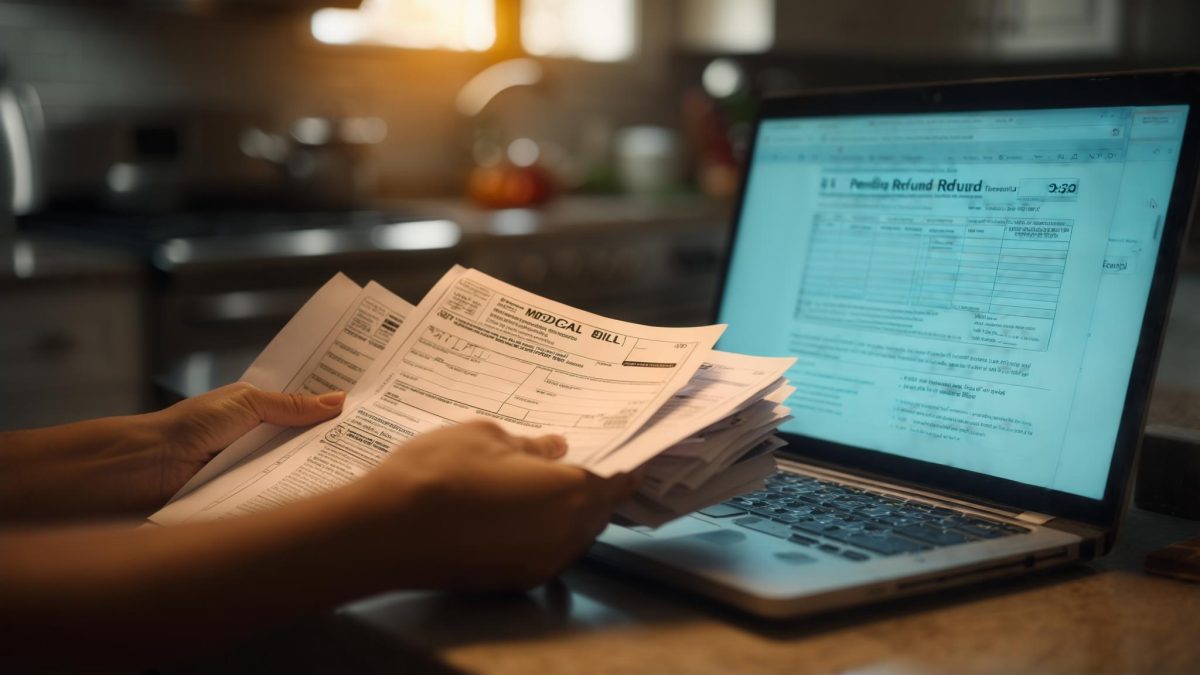
The conventional wisdom about tax refunds goes something like this: file early, get paid fast, move on. For millions of Americans, that is roughly true. For the ones carrying COBRA premiums that cost more than rent and credit card balances from last year’s emergency room visit, the gap between “approved” and “deposited” can feel like a different kind of emergency entirely.
Gina Patel reached out to Check Day America in late February 2026, about three weeks after she had filed her federal return. She had read a piece I wrote the previous fall about IRS identity verification delays and sent a short message through our contact form: “This happened to me. Still happening. Is anyone writing about this?” I called her the next morning.
The Setup: A Budget Built Around a Refund That Hadn’t Arrived Yet
When I sat down with Gina Patel over a video call on a Thursday evening — she had just finished a twelve-hour shift at a hospital in the North Hills area of Pittsburgh — the first thing she showed me was a handwritten budget on a legal pad. It was divided into two columns: what she owed each month, and what she was waiting on.
In the “waiting on” column, circled twice in red pen, was $3,412. That was the federal refund amount shown on her completed 2025 return, which she had filed electronically on February 6, 2026. She had used a free filing service through the IRS Free File program and received an acceptance confirmation the same day.
Gina had been on COBRA since October 2025, when her hospital reduced her to part-time status during a staffing restructure. Her premium — $1,847 per month for herself and two of her four children still living at home — was, by her own accounting, $214 more than her mortgage payment. “I’m a nurse,” she told me, not bitterly, just flatly. “I know what healthcare costs. I just never thought I’d be the one staring at that number every single month.”
The Medical Emergency That Started Everything
The COBRA situation was downstream of something worse. In July 2025, Gina’s 16-year-old son Marcus had an emergency appendectomy. He was on her employer plan at the time, and between the deductible and out-of-pocket costs that her insurance disputed for nearly two months, Gina ended up putting approximately $9,200 on two credit cards to keep the bills from going to collections while the appeals process dragged on.
By the time I spoke with her in late February 2026, that balance had grown to roughly $11,400 with interest. Her minimum monthly payments alone totaled $340.
The $3,412 refund was not going to solve everything. Gina knew that. But it would cover two months of COBRA premiums and chip away at the credit card minimum payments long enough for her to pick up extra shifts in the spring. She had already spoken with her charge nurse about moving back to full-time status by May. The refund was a bridge, not a rescue.
When “Accepted” Stopped Meaning What She Thought It Meant
The IRS typically issues most electronically filed refunds within 21 days of acceptance, according to IRS guidance on refund timelines. Gina knew this. She had checked the Where’s My Refund tool the morning of February 27 — 21 days after her acceptance date — and seen her status shift from “Return Received” to something she had not encountered before: “Your return has been selected for further review.”
No dollar amount. No estimated date. No explanation beyond a generic message directing her to wait for a letter.
The letter arrived on March 9 — a Letter 5071C asking Gina to verify her identity online at the IRS Identity Verification Service or by phone. She completed the online verification the same day it arrived. The tool confirmed her identity was verified. And then, again, she waited.
The Waiting, and What It Actually Costs
As Gina explained during our second call in mid-March, the waiting was not passive. It was a daily recalculation. Her COBRA payment for February had come due on the 15th. She paid it — barely — by deferring a credit card minimum payment, which triggered a late fee of $39. Her March COBRA bill was due on March 15 as well.
“I’m not someone who misses payments,” she told me. “I’ve been paying bills on time since I was 23 years old. And now I’m sitting here deciding which thing to be late on.”
When Gina checked her bank account on the morning of April 26, she saw a deposit of $2,890 — not $3,412. A separate notice arrived two days later explaining that $522 had been withheld under the Treasury Offset Program and applied to a Pennsylvania state tax liability she had disputed in 2022 but apparently never fully resolved.
What the Numbers Actually Looked Like at the End
The outcome for Gina was mixed in the way that financial lives often are — neither a clean rescue nor a collapse. The $2,890 she received covered her April COBRA premium and allowed her to bring both credit card accounts current. It did not eliminate the $11,400 balance. It did not resolve the $522 offset question, which she told me she planned to address by contacting the Pennsylvania Department of Revenue directly.
The Treasury Offset Program allows the federal government to redirect tax refunds toward certain federal and state debts — including back taxes, child support, and defaulted student loans — before the remainder reaches the taxpayer. The IRS is required to notify taxpayers of such offsets, but the notice does not always arrive before the deposit, which is what happened in Gina’s case.
The Part She Didn’t Expect to Feel
When I spoke with Gina one final time in late April, a few days after the deposit had cleared, she was not celebratory. She was, in her own word, “steadier.” She had paid her April COBRA bill. She had made minimum payments on both credit cards. She had looked up her Pennsylvania tax account online and confirmed the $522 offset amount, which she believes stems from a 2022 return she filed late following her divorce finalization.
“I’m not angry at the IRS,” she told me. “I understand there are reasons for the delays. I just wish someone had told me upfront that ‘approved’ doesn’t mean ‘on the way.’ Those are two different things and for some people, that gap is a real crisis.”
She is back to full-time hours starting May 1. Her employer-sponsored health coverage resumes June 1, which means one more COBRA payment — her last — due in mid-May. She has already set that money aside.
The legal pad with the two columns is still on her kitchen counter, she said. The “waiting on” column is empty now. That counts for something, even if the number that arrived was smaller than the one she had written in red.
Related: Someone Filed a Tax Return in His Name. The IRS Held His $3,200 Refund for 14 Months.
Related: A Firefighter’s COBRA Bill Hit $1,847 a Month — More Than His Rent — After a Friend’s Loan Default



Leave a Reply