

Have you ever known exactly what to do — followed every rule, checked every box — and still found yourself completely at the mercy of a process that doesn’t care how prepared you are?
I met Doris Okonkwo on a Thursday afternoon in mid-March at a Shell station on Montana Avenue in El Paso. She was standing behind me in the small convenience line, phone pressed to her ear, speaking in the measured, almost emotionless tone of someone who has rehearsed disappointment so many times it no longer registers as pain. I caught fragments: “…still says processing…” and “…the contractor won’t hold the quote past Friday.”
When she hung up, I turned and introduced myself. She looked at me the way people do when they’re too tired to be guarded. Within ten minutes, we were sitting in her car in the parking lot, and she was telling me everything.
The Refund That Was Supposed to Fix Everything
Doris Okonkwo is 52 years old, works as a senior accountant for a mid-size logistics firm, and lives in a three-bedroom house in the lower valley of El Paso that she shares with a roommate to help cover costs. Despite her professional title, her income has hovered in the low range for the past several years — a combination of a pay freeze, rising insurance premiums, and a mortgage she describes as a weight she “walked into with both eyes open and still underestimated.”
Her monthly mortgage payment is $1,740 on a home currently assessed at roughly $178,000. She owes closer to $201,000 on it. The numbers, she told me flatly, “stopped shocking me a long time ago.”
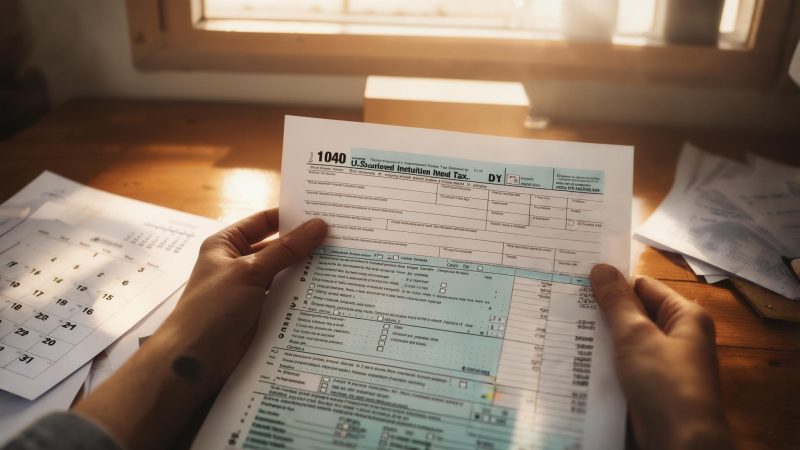
When she filed her federal return on February 3, 2026 — electronically, using software she’s trusted for years — she was counting on one thing: the $2,847 refund she was owed. Not as savings. Not as a bonus. As a patch, literally, for a section of roof above her back bedroom that had been leaking since November.
“I had a contractor lined up. Quote was $3,900. I was going to put the refund toward it and pull the rest from what I had left in checking,” she told me. “I filed early specifically because of that. I knew what I needed and when I needed it.”
What the IRS Portal Said — and What It Didn’t
For the first two weeks after filing, the IRS’s Where’s My Refund tool showed the standard first bar: Return Received. By February 17, it had moved to the second bar: Refund Approved. Doris told me she exhaled for the first time in months.
Then nothing happened. Days passed. The tool stopped updating.
Around February 28, the portal reverted. Instead of two bars filled, there was a message she didn’t expect: her return was being reviewed and she should allow additional time. No notice number. No explanation. According to the IRS Topic 152 page, delays can occur for a range of reasons including identity verification, math errors, or random selection — and the agency may not issue a formal letter for several weeks.
“I process numbers for a living,” Doris said. “I know what an IRS review means. I went back through everything — W-2, the interest statement from my mortgage servicer, a small amount of freelance work I reported on a Schedule C. Everything was right. I couldn’t find an error because there wasn’t one.”
The Contractor Deadline and the Ceiling That Kept Getting Worse
The practical consequences of the delay were immediate. Doris’s contractor — a small roofing company she’d used once before — told her in early March that he couldn’t hold the $3,900 quote past March 6. She asked for an extension. He gave her until March 13. By then, her refund still hadn’t moved.
She lost the booking. When she called again in late March, he quoted her $4,600 — citing material costs that had risen since February. The ceiling in the back bedroom had developed a second water stain during a heavy rain event on March 9.
Doris called the IRS on March 4. She was on hold for 34 minutes before reaching a representative who told her the return was still under review and she should allow up to 60 days from the date of the original letter — except no letter had arrived yet. “He was reading from a script,” she said. “He wasn’t unkind. He just didn’t have anything real to tell me.”
She received an IRS CP05 notice dated March 11, 2026 — more than five weeks after filing. The notice confirmed her return had been selected for review to verify income and withholding information. It asked her to do nothing and allow 60 additional days. According to the IRS’s CP05 explanation page, this type of notice does not necessarily mean an error was found — it’s a hold triggered by the agency’s internal verification filters.
What 11 Weeks of Waiting Looks Like From the Inside
When I sat down with Doris again — this time over coffee near her office on a Tuesday in late March — she had a quality I’ve come to recognize in people who’ve been managing financial stress for a long time. She wasn’t panicked. She wasn’t angry, exactly. She was just worn in a particular way, like a document that’s been folded and unfolded too many times.
“You know what’s strange?” she told me. “I help clients understand their finances. I explain IRS procedures to people. And then I’m sitting in my own house watching a water stain grow and I can’t do anything because I’m waiting on money that’s already mine.” She paused. “There’s a word for that feeling but I stopped using it.”
She hadn’t tapped her emergency savings — what remained of it, roughly $1,100 — because she was afraid to. Her roommate contributes $650 per month toward household expenses, which helps, but Doris’s mortgage, utilities, and car insurance leave almost no margin. The refund wasn’t a luxury. It was a load-bearing number in her monthly math.
The Deposit Arrived — But the Math Had Already Changed
On the morning of April 1, 2026 — 57 days after filing — Doris’s bank account received a direct deposit of $2,847 from the U.S. Treasury. No prior update on the portal. No notice that the review had concluded. The money simply appeared.
When I reached her by phone that afternoon, she confirmed the deposit. Her tone hadn’t changed much. “It’s there,” she said. “Good.”
But the roofing quote had risen to $4,600 by then. She was now $1,753 short of covering the full repair — more than she’d been short when she was waiting. She told me she’d call the contractor that week and see whether she could split the job into phases, doing the most critical section first for around $2,400 and leaving the secondary portion for later in the year.
There was no triumphant moment. No turning point where things snapped back into place. The money came, and the problem it was meant to solve had grown in the interim. That’s the version of this story that doesn’t get told often enough.
What Doris’s Experience Reflects About IRS Processing in 2026
Doris’s situation isn’t an outlier. The IRS processed approximately 163 million individual returns in fiscal year 2024 and issued more than 112 million refunds, according to IRS filing season statistics. A meaningful share of those returns are held for additional review each year — the CP05 notice alone is one of the most commonly issued IRS letters during filing season.
The 21-day standard for e-filed refunds is accurate for the majority of returns. But “majority” is a cold comfort when your return is among the ones selected for manual review. The gap between what the IRS says is typical and what an individual taxpayer actually experiences can span weeks or months, and the portal offers limited visibility into why.
For someone like Doris — whose financial life has almost no buffer — the difference between a 21-day wait and an 11-week wait isn’t just inconvenient. It’s structural. It reshapes what she can afford, when she can afford it, and what the cost of waiting turns out to be.
When I asked her what she wished she’d known before filing, she thought about it for a moment. “I’d have planned for the worst case,” she said. “Not the average. The worst case. Because when you’re already at the edge, the average doesn’t protect you.”
I drove home from that last conversation thinking about the particular exhaustion of being competent in a system that remains indifferent to competence. Doris Okonkwo knew exactly what she was doing. She filed early, filed correctly, and selected direct deposit. She did everything right. The roof still leaked. The quote still rose. The money still came late.
That’s not a failure of knowledge. It’s just what waiting costs — and the IRS doesn’t put that on any form.
Related: The College Tax Credit This Pittsburgh Mom Almost Missed While Juggling a 30% Rent Hike
Related: Wage Garnishment, a Failing Roof, and No Safety Net: Inside One Family’s Struggle to Hold On


Leave a Reply