

Have you ever watched a number on a government website and felt your entire financial plan hinging on whether it changes from one word to another? When I sat down with Tanya Fitzgerald on a Tuesday afternoon in late March, she still had the IRS Where’s My Refund tool bookmarked on her phone — even though her money had finally arrived weeks earlier. Old habits, she told me, die hard when you’ve been watching a screen every morning hoping today is the day.
I first heard about Tanya through a woman named Carol, a Meals on Wheels coordinator I was riding along with for a separate story in Tampa’s Sulphur Springs neighborhood. Carol mentioned, almost in passing, that one of her regular volunteers had been dealing with a months-long tax refund situation that had nearly pushed her into overdraft. I asked Carol if that volunteer would be willing to talk. Two days later, Tanya called me back.
A $2,190 Refund and a Very Specific Plan
Tanya Fitzgerald is 50 years old, works the front desk at a mid-range hotel near Tampa International Airport, and earns approximately $32,000 a year. She is divorced, pays $380 per month in child support for her two children, and carries roughly $4,200 in credit card debt that originated from an emergency appendectomy in the spring of 2024 — a bill her insurance covered only partially. She also holds $34,000 in federal student loan debt from a graduate degree in hospitality management that she completed in 2019 and that has not yet translated into the salary bump she was promised it would.
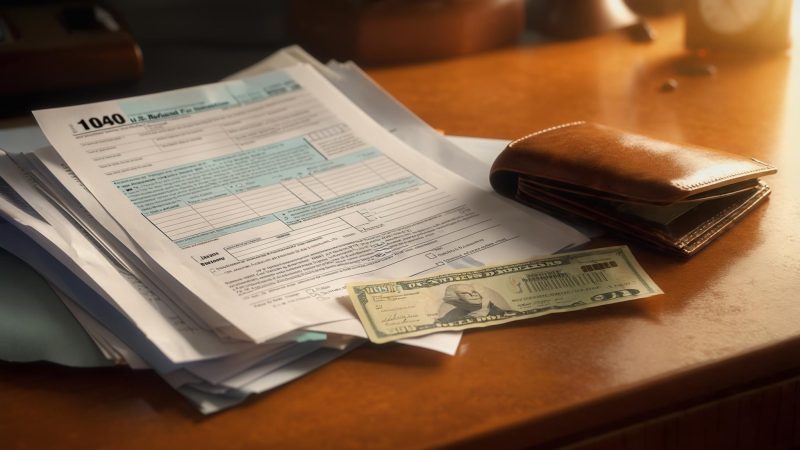
When she filed her 2025 federal tax return on January 31, 2026, TurboTax told her she was owed $2,190. That figure included a partial Earned Income Tax Credit and a small education credit she had claimed the year prior. She had already done the math on where that money was going.
“I had $600 of it going toward that credit card,” Tanya told me, sitting across from me at a Panera near her apartment. “Another $400 I was going to put in savings because I literally have $212 in savings right now. The rest I needed for a car repair I’ve been putting off since November.” She smiled in a way that didn’t entirely reach her eyes. “I had it all organized in a spreadsheet.”
Thirty-Eight Days of ‘We Have Received Your Return’
The IRS typically issues refunds within 21 days for e-filed returns with direct deposit, according to IRS.gov’s refund information page. Tanya’s return cleared that window and kept going.
From February 1 through March 10 — 38 consecutive days — the Where’s My Refund tool showed the same status: “We have received your tax return and it is being processed.” No update. No estimated deposit date. Just the same static message that, as Tanya described it, started to feel almost mocking.
She called the IRS on February 24, after the 21-day mark had passed. The wait time that morning was listed as approximately two hours and fifteen minutes. She called from her car during a lunch break, put the phone on speaker, and listened to hold music until her break ended. She called again the following Saturday and waited one hour and forty minutes before reaching an agent, who told her only that her return was “under review” and that she should expect a notice by mail.
That notice arrived on March 5. It was a CP05 notice — a form the IRS issues when it selects a return for additional review of income, withholding, or tax credits before issuing a refund. The notice did not specify what triggered the review. It told her to wait up to 60 days from the notice date before contacting the IRS again.
The Letter That Changed the Number
On March 14, Tanya’s Where’s My Refund status finally updated — but the news was not entirely what she had been waiting for. The tool now showed a deposit date of March 25, 2026. The amount listed: $1,847. She was owed $2,190. No one had told her why $343 had disappeared.
A second letter arrived shortly after. This one was from the U.S. Department of the Treasury’s Bureau of the Fiscal Service, not the IRS. It explained that $343 of her refund had been intercepted under the Treasury Offset Program, or TOP, and applied to a delinquent federal student loan balance. According to the Bureau of the Fiscal Service, the Treasury Offset Program allows federal and state agencies to collect delinquent debts by reducing tax refunds, federal salaries, and other federal payments.
“I read it three times,” Tanya told me. “I didn’t even know that was a thing they could do. I thought I was current on my loans — I’m on an income-driven repayment plan. But apparently one of my loans had gone into a different status and I hadn’t gotten the notice or I missed it. I still don’t fully understand what happened.”
Taxpayers can check in advance whether their refund is at risk of being offset by calling the TOP hotline at 1-800-304-3107, according to the IRS’s Tax Topic 203. Tanya had not known that line existed. She found out about it only after she received the offset letter — and by then, the $343 was already gone.
When the Money Finally Arrived
On March 25, 2026, $1,847 landed in Tanya’s checking account. She had been overdrawn by $64 the week before — a situation she covered by borrowing from a coworker — so the deposit first zeroed out a small negative balance and then settled into her account. The spreadsheet she had made in January needed revising, but she remade it the same evening.
“You adjust,” she said, and her voice carried the particular flatness of someone who has adjusted many times before. “The shoes can wait until summer. I’ve been doing this — adjusting — for about six years now. You get good at it.”
The car repair, a failing alternator on a 2014 Honda Civic, was completed the following week for $712. The credit card payment brought her balance from $4,200 down to $3,600. Her savings account now holds $512 — the most it has held, she told me, since her divorce finalized in 2020.
The Part She Is Still Working Through
What lingered for Tanya was not the delay or even the $343 offset, though both frustrated her. It was the feeling of being processed — of having her financial situation touched by systems she could not see or reach, receiving letters that assumed a fluency in bureaucratic language she had never been taught.
“Nobody explains this stuff,” she told me near the end of our conversation. “I have a graduate degree. I’m not an uneducated person. And I still couldn’t figure out what half those letters meant without Googling every third sentence. That can’t just be me.”
She plans to file earlier in 2027 — in mid-January, as soon as the IRS opens the filing window — and to call the TOP hotline before she files to check for any outstanding offsets. She also said she intends to contact her student loan servicer directly to clarify the status of the loan that triggered the intercept, something she had not yet done as of the date we spoke.
Before I left, I asked Tanya whether she felt the system had treated her fairly. She thought about it for a moment longer than I expected.
I drove home thinking about that sentence. Fifty-four days is a long time to watch a screen when $2,190 represents the difference between a car that runs and one that doesn’t — between $512 in savings and zero. Tanya’s refund arrived. Her car runs. Her savings account has a small but real number in it. And she is already thinking about how to do next year differently, which strikes me as either hopeful or exhausting, depending on the day you ask her.



Leave a Reply