
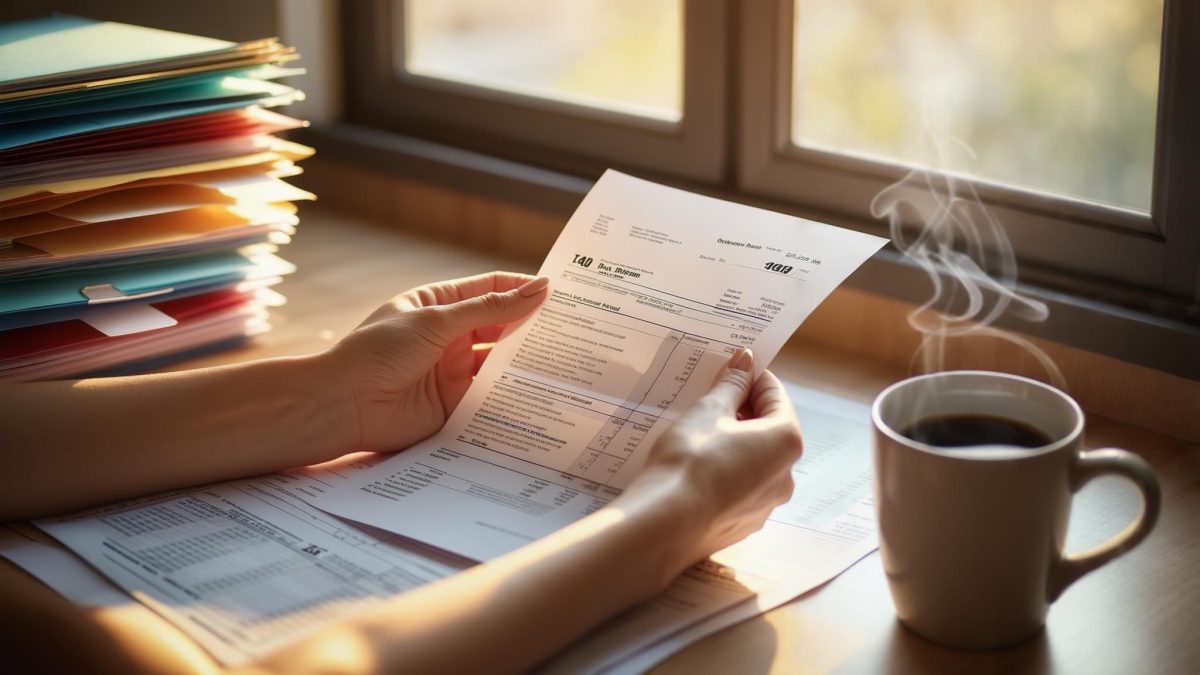
The 2026 tax filing season is still open, and for millions of low-income households, the window to file and receive a refund before summer bills stack up is narrowing fast. For some families, a federal tax refund is not a bonus — it is the budget. When I first heard about Monique Gutierrez, that distinction felt abstract. After spending two hours with her at a coffee shop near her home in Oklahoma City’s Midwest City neighborhood, it no longer does.
A credit union manager at a local branch reached out to me in late March. She had just seen Monique come in asking about hardship loan options and suggested I speak with her — not because her situation was unusual, but because it was ordinary in a way that most people never talk about out loud. Monique agreed to sit down with me the following week.
A Budget Built Around One Annual Deposit
Monique Gutierrez is 53 years old, a legal secretary for a mid-size family law firm in Oklahoma City. She has been doing the job for eleven years. Her husband, Darnell, works part-time as a warehouse receiving clerk. Together, they are raising two children — Marcus, 8, and Leila, 6. Their combined household income for 2025 came to roughly $38,400 before taxes.
When I sat down with Monique, she pulled out a small spiral notebook — the kind you find in a dollar store — and laid it flat on the table. Every monthly expense was written in ink, with projected shortfalls circled in red. February had three red circles.
Monique filed her 2025 federal return on February 14, 2026 — Valentine’s Day, which she noted with a dry laugh. She filed electronically through a free tax prep service and chose direct deposit. The IRS accepted her return the same day. Then the waiting started.
The Prescription Problem No One Warned Her About
Before the refund arrived, Monique was managing a second crisis quietly. In January 2026, her employer switched group health insurance carriers. The new plan — effective February 1 — did not cover one of her two maintenance medications at the same tier. Her monthly out-of-pocket prescription cost went from $34 to approximately $214. The change was buried in a packet she received over the holidays.
She told me she went three weeks without the medication in February because she was waiting to see if the refund would come before a late property tax penalty hit on March 1. Oklahoma counties can begin the lien process after a 90-day delinquency, and Monique’s account was already past that threshold.
“I was checking ‘Where’s My Refund’ every morning before I made coffee,” she told me. “Every day it said ‘Return Received’ and then ‘Refund Approved’ and then nothing. I didn’t know if I should just wait or start panicking.”
The IRS tool — formally called Where’s My Refund — updates once daily, typically overnight. Most e-filed returns with direct deposit are processed within 21 days, according to IRS guidance. Monique’s took 31. She did not know why, and she never received a notice explaining the delay.
What Arrived on March 17 — and What It Had to Cover
On March 17, 2026, Monique’s direct deposit of $2,847 cleared her checking account. She had already written out a priority list in that same spiral notebook. The money was spoken for before it arrived.
The refund’s size was shaped partly by the Child Tax Credit. For tax year 2025, eligible families can claim up to $2,000 per qualifying child, according to IRS guidelines — with a refundable portion available even for families with limited tax liability. Monique’s two children, both under 17, contributed meaningfully to her final refund figure.
The Stimulus Rumors She Was Following — and What’s Actually True
Monique told me she had been tracking social media posts about a possible $2,000 stimulus check tied to tariff revenue — a proposal that circulated heavily throughout late 2025 and into 2026. She was not alone. According to TIME, a White House official confirmed that President Trump is “committed” to following through on a tariff dividend concept, but no detailed legislative plan has been released.
She had done her own research. “I saw people online saying checks were going out in February. I even called my bank to ask if something had posted that I missed,” she told me. Nothing had posted. As Investopedia reported in its February 2026 fact-check, no new federal stimulus payment had been authorized or distributed — and many of the circulating claims were either mischaracterizations of existing programs or outright misinformation.
Some states have moved forward with their own relief measures. According to Kiplinger, several states are distributing tax rebates and property relief payments in 2026, though Oklahoma is not currently among them. Monique had looked into that too. “I checked. We’re not on the list,” she said flatly.
What the Credit Union Visit Was Really About
After the refund arrived and the property taxes were paid, Monique still went to the credit union. That is how I first heard about her. The visit was not for a loan — it was for a conversation about what happens next year. She wanted to know if there was a way to structure a small savings account that her family couldn’t easily dip into, something set aside specifically to cover the property tax bill before it became a crisis again.
The credit union manager told her about a certificate product with a fixed term — Monique didn’t commit to anything that day, but she left with paperwork. What struck the manager, she told me afterward, was that Monique had already done the math. She knew that if she set aside $120 a month starting in April, she would have roughly $1,440 by next March — just enough to cover the tax bill without touching the refund.
“I used to feel embarrassed coming in here,” Monique told me as we wrapped up. “Like I was the only one who couldn’t figure it out. But everybody I know is doing the same math. They’re just not saying it out loud.”
She picked up her notebook, tucked it into her purse, and said she needed to get to the pharmacy before picking up Leila from school. The $425 buffer was already down to $310 — a water heater repair from two weeks ago. She said it without bitterness. She said it like someone who has learned to keep updating the plan.
I watched her walk to her car in the parking lot. The refund had done what it was supposed to do. It bought stability for a few months. Whether anything beyond that — a tariff dividend, a state rebate, a change in her insurance tier — would arrive before the next red circle appeared in that notebook, nobody could say for certain. Not yet.
(function(){var w=document.getElementById(‘pvv-scenario-s177566501905343uw’);if(!w)return;var btns=w.querySelectorAll(‘button[data-choice]’);btns.forEach(function(b){b.addEventListener(‘click’,function(){if(w.dataset.revealed)return;w.dataset.revealed=’1′;btns.forEach(function(x){x.style.opacity=x===b?’1′:’0.45′;x.style.cursor=’default’;x.style.transform=’none’});var o=document.getElementById(‘s177566501905343uw-out-‘+b.dataset.choice);if(o){o.style.display=’block’}});b.addEventListener(‘mouseenter’,function(){if(!w.dataset.revealed){b.style.borderColor=’#38bdf8′;b.style.transform=’translateX(4px)’}});b.addEventListener(‘mouseleave’,function(){if(!w.dataset.revealed){b.style.borderColor=’#334155′;b.style.transform=’none’}})})})();
.pvv-faq-section details summary::-webkit-details-marker{display:none}.pvv-faq-section details summary::marker{display:none;content:””}.pvv-faq-section details[open] summary .pvv-faq-arrow{transform:rotate(90deg)}




Leave a Reply