

By the end of February 2026, the IRS had received more than 46 million tax returns, according to Kiplinger’s refund calendar. For most filers, a refund is a welcome bonus — a chance to pad savings or pay down a credit card. For Felicia Hensley, 59, a front desk manager at a mid-scale hotel in Indianapolis, it was something closer to oxygen.
A financial counselor named Sandra Pruitt connected me with Felicia in mid-March. Sandra had been working with Felicia for several months and told me, without hesitation, that her client’s story deserved to be heard. When I sat down with Felicia at a Panera Bread off Meridian Street on March 18th, she arrived ten minutes early, ordered nothing, and folded her hands on the table like someone who had learned to be patient whether she wanted to be or not.
A Budget Built on Assumptions That Stopped Being True
Felicia has worked in hospitality for twenty-two years. Her current position pays approximately $38,400 annually — but hotel desk work runs on rotating shifts, and the hours are rarely consistent. Some weeks she clears 40 hours. Some weeks she clears 28. Her husband, Marcus, works part-time at a warehouse and brings in roughly $860 a month depending on availability.
Together, they are raising two kids — a 14-year-old and an 11-year-old — in a rental home on the northwest side of Indianapolis. For three years, their rent held at $1,095 a month. Then, at their January 2026 lease renewal, the landlord sent notice of an increase to $1,424. That is a jump of $329 per month, or approximately 30 percent.
At roughly the same time, Felicia’s employer switched insurance carriers. Her previous plan had covered a blood pressure medication and a thyroid prescription at a combined copay of $47 a month. Under the new plan, the same medications totaled $412 a month until she meets a $1,800 deductible. She has not met it yet.
Filing Early, Waiting Longer Than Expected
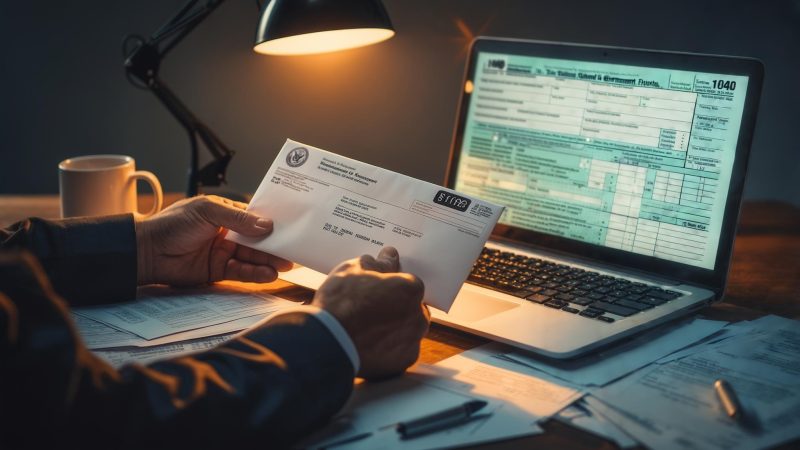
Felicia filed her 2025 federal tax return on February 6th, 2026, using TurboTax. She selected direct deposit, entering the routing and account number for the family’s checking account at a regional credit union. TurboTax confirmed that the IRS accepted her return on February 8th. She expected the refund — $2,847 — within 21 days, which is the standard window the IRS cites for most electronically filed returns with direct deposit.
The IRS’s Where’s My Refund tool showed one status: Return Received. It stayed there for eleven days. Then, on February 19th, the status shifted to Refund Approved. Felicia told me she exhaled for the first time in weeks. The tool said she should expect her deposit by February 24th.
February 24th came. Nothing hit the account. She checked the portal. It still said approved. She checked again on February 26th. Same message. She called the IRS helpline on February 28th and waited on hold for 1 hour and 47 minutes before the call disconnected.
The Stimulus Rumor Problem Made Everything Worse
While Felicia was waiting, her Facebook feed filled with posts claiming the government was issuing new stimulus checks — $2,000 payments tied to tariffs, $1,700 “tariff refunds” linked to a Supreme Court ruling, even claims of IRS direct deposits going out in February 2026. She forwarded me screenshots of three separate posts she had saved.
Felicia told me she spent two evenings trying to verify whether any of these payments were real, using her phone after the kids were in bed. She found an article from Investopedia’s fact-check on February 2026 stimulus claims, which found no credible basis for the payments being described. A report from Fox 5 DC’s fact-check reached the same conclusion — the claims about tariff dividends and new IRS stimulus deposits spreading online in early 2026 were misinformation.
The confusion cost her something harder to quantify than money. She told Sandra Pruitt she had spent nearly six hours across three days researching payment rumors that turned out to be false — time she could not afford to lose, energy she did not have to spare.
What Finally Changed — and What It Cost Her in the Meantime
Felicia’s refund hit her credit union account on March 15th, 2026 — 37 days after the IRS accepted her return, and 19 days after the portal said she should expect her deposit. She never received an explanation for the delay. No letter arrived. No notice appeared in her IRS online account. The money simply appeared.
By that point, she had already paid March’s rent late — the landlord charged a $75 late fee. She had borrowed $300 from her sister to cover one month of prescriptions. Her 14-year-old had asked twice why the family wasn’t eating out anymore, and Felicia told her they were “saving up for something.”
When I asked Felicia how she felt when the deposit appeared, she paused for a long moment. “Relieved,” she said. Then: “And angry. Because the relief shouldn’t have taken this long. I did everything right. I filed early. I picked direct deposit. I checked the portal every single day. And I still ended up borrowing money from my sister and splitting my medication.”
The Broader Picture Behind One Family’s Wait
Felicia’s experience is not unusual in its mechanics, even if the personal stakes were unusually high. The IRS processed approximately 152 million individual returns in 2025, and the agency has faced staffing pressures and system backlogs that have occasionally stretched the standard 21-day window. According to the IRS Fact Sheet FS-2026-02, the agency has been working to modernize its payment infrastructure under Executive Order 14247, with a stated goal of expanding direct deposit reach and reducing processing delays.
For filers like Felicia — low-income households with no savings buffer, irregular income, and mounting fixed costs — a 37-day refund timeline is not an inconvenience. It is a cascading financial event. The $75 late fee she paid represents roughly two hours of her gross wages. The prescription splitting she described carries real clinical risk.
Before I left that Panera on Meridian Street, I asked Felicia what she wished she had known going into this filing season. She thought about it seriously, the way someone does when they’re constructing a sentence they’ve already rehearsed inside their head.
She also said she wished someone had told her earlier that the viral stimulus posts flooding her feed were false. “I don’t need to spend six hours chasing something that isn’t real,” she said. “I needed that time. I needed that energy.”
Felicia Hensley did everything the IRS asks of a taxpayer. She filed electronically, she chose direct deposit, she checked the tracking tool. She waited 37 days anyway, borrowed money from family, split her medication, and paid a late fee she should not have had to pay. Her story does not resolve with a lesson or a tidy moral. It resolves with a deposit that arrived three weeks late and a family trying, quietly and without complaint, to stay level on ground that keeps shifting beneath them.
Related: Her Co-Signed Loan Went Bad, Her Business Stalled, and Then Medicare Ate Her Social Security Raise

Leave a Reply