

Have you ever made a plan around money that wasn’t technically yours yet — and then watched that plan fall apart day by day as a government system stalled without explanation? That question stayed with me after a chance encounter at a Shell station on SE Powell Boulevard in Portland, Oregon, on a Tuesday afternoon in early March 2026.
I was filling my tank when I heard a woman behind me — phone pressed to her ear, voice tight with frustration — saying something like, “They’ve had my money for six weeks and the website just says ‘processing.’ How is that legal?” I turned around. She was maybe late twenties, wearing a lanyard that said Pacific Coast Community Bank, clearly on a lunch break. I introduced myself and asked if she’d be willing to talk. She hesitated — then said, “Sure. Because honestly, someone should know this is happening.”
That was Denise Hargrove, 27, a full-time bank teller from Portland who had filed her 2025 federal tax return on January 28, 2026, and was still waiting for a $1,847 refund that the IRS had acknowledged receiving. By the time we sat down properly a few days later at a coffee shop near her apartment, that wait had stretched to 63 days.
A Refund With a Lot Riding On It
Denise’s financial picture is the kind that doesn’t leave much room for error. She earns approximately $38,000 a year as a bank teller — a fact she acknowledged with a dry laugh, noting the irony of processing other people’s deposits while watching her own account balance. Her partner, Marcus, is finishing a two-year community college program and not yet working full-time. Their combined monthly income hovers around $3,100 after taxes.
The $1,847 refund — generated by her W-2 withholding and a modest Earned Income Tax Credit — wasn’t a windfall. It was a lifeline she had mapped out carefully. Her most pressing problem: an auto loan she described as “completely upside down.” She owes roughly $18,400 on a 2020 Honda Civic that a dealership recently appraised at around $12,000. She had planned to use part of the refund to make two overdue payments and potentially explore a refinance option before interest compounded further.
“I had a spreadsheet,” she told me. “I know exactly where every dollar of that refund was supposed to go. And every day it didn’t show up, I had to move something else around just to cover the gap.”
The CP05 Notice: When “We Received Your Return” Stops Being Reassuring
Denise had e-filed through a free tax software platform on January 28. The IRS accepted her return two days later, on January 30. According to IRS Where’s My Refund, most electronically filed returns that claim a refund are processed within 21 days — a timeline the agency has consistently published. Denise knew this. She checked the portal every morning.
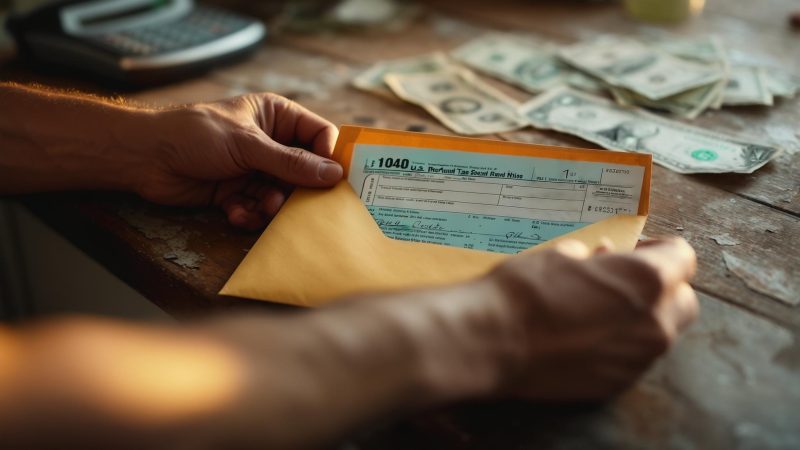
On February 24 — 25 days after acceptance — the status still read “processing.” No deposit date. No error. Just the spinning indicator and a note that her return was being reviewed. Then, on March 3, a physical letter arrived at her apartment: IRS Notice CP05.
A CP05 notice is not a red flag in the criminal sense — it is a routine review hold. But for someone counting days against overdue loan payments, “routine” is a cold word. The IRS’s own guidance, published at IRS.gov CP05 guidance, tells recipients to wait up to 60 days before following up. That instruction, Denise said, felt like a door being slammed.
A History That Made Waiting Harder
Denise’s frustration wasn’t coming from nowhere. When I asked her to explain her wariness toward financial institutions, she went quiet for a moment before answering carefully. In 2023, she had claimed a refund of $2,300 that was flagged for identity verification — a process that required her to complete an in-person appointment at an IRS Taxpayer Assistance Center. The nearest open appointment at the time was in Salem, Oregon, a 50-mile drive, and the first available slot was six weeks out.
That year’s refund arrived 104 days after she filed. She had already borrowed $800 from her mother to cover expenses she’d planned to pay with the refund. She paid it back, but the dynamic stung. “I felt stupid for counting on it,” she said.
That experience shaped how she approaches institutions — banks, lenders, government agencies. She doesn’t expect them to move quickly for people in her income bracket. Her skepticism isn’t irrational. It’s earned.
What the 63-Day Wait Actually Cost Her
When Denise’s refund finally arrived on March 31, 2026 — deposited directly to her checking account — it was the full $1,847 she’d expected. No reduction, no partial payment. From the IRS’s perspective, the case closed cleanly. From Denise’s perspective, the damage had already been done in smaller, compounding ways.
She had missed one car payment in February, which triggered a $47 late fee. She had put $310 in medical copays on a credit card she’d been trying to pay down, which now carried a higher balance. She had not been able to pursue the refinancing conversation she’d planned, because the lender she spoke with said her debt-to-income ratio — with the overdue auto payment on record — made the timing difficult.
“The refund came. That’s fine,” Denise said, when I asked how she felt on the day it arrived. “But I didn’t get back the late fee. I didn’t get back the interest on the credit card. And the refinancing window — I don’t know when that comes back around. So I got my money, but I also didn’t get my plan back. Those are two different things.”
What Denise Wishes She Had Known
Sitting across from Denise, I was struck by how methodical she was about all of it — not angry in a way that felt performative, but genuinely analytical. She’d looked up the CP05 notice, read the IRS guidance, called the IRS helpline once (on hold for 74 minutes before hanging up), and eventually found the Taxpayer Advocate Service — a free, independent office within the IRS that assists people experiencing financial hardship due to refund delays.
She didn’t ultimately file a TAS hardship request, partly because she wasn’t sure she met the threshold and partly because she didn’t trust that doing so wouldn’t trigger a deeper review. But she said knowing the option existed would have helped earlier. “If I’d known about it in week three instead of week seven, I might have done something differently,” she said.
- Where’s My Refund tool: Available at IRS.gov; updates once daily, typically overnight
- IRS2Go mobile app: Same data as the web tool; useful for quick status checks
- Taxpayer Advocate Service: File Form 911 to request help if a delay is causing financial hardship
- IRS Identity Protection PIN: An opt-in six-digit code that can prevent identity-related holds on future returns
Denise also said she planned to adjust her withholding for 2026 so she doesn’t end up with a large refund to wait on. “I’d rather have the money in my paycheck every two weeks than loan it to the IRS interest-free and then beg for it back,” she said. That’s a calculation a lot of filers make — though the tradeoff means smaller paychecks require stricter month-to-month budgeting, which carries its own risks for someone on a fixed income.
The Bigger Picture Behind One Delayed Refund
Denise Hargrove’s story isn’t statistically unusual. The IRS processed approximately 271 million tax returns in fiscal year 2024, according to agency data, and the vast majority of refunds were issued within the standard window. But when delays occur — whether from CP05 review holds, identity verification flags, or system backlogs — they tend to land hardest on filers who have the least cushion to absorb them.
The 63-day wait Denise experienced is not at the extreme end of the delay spectrum. Some filers have reported waits of five months or longer after identity-related complications, particularly those who were victims of prior tax-related identity theft. The IRS has acknowledged in recent years that its backlog issues, which peaked dramatically during the pandemic years, have improved — but the CP05 review process remains a common source of extended delays for middle-income filers claiming refundable credits.
When I left the coffee shop that afternoon, Denise was heading back to her shift. She’d already transferred $620 of the refund to cover the overdue car payment and late fee. The remaining $1,227 went into a checking account buffer she said she was determined to keep intact. The refinancing conversation, she acknowledged, would have to wait for another quarter.
She didn’t sound defeated. She sounded, if anything, more certain than before — certain that she couldn’t afford to rely on timing she couldn’t control. That kind of hard-won clarity tends to come with a price tag. In Denise’s case, it was 63 days and $47 she’ll never see again.
Related: The Workers’ Comp Denial That Cost Aisha Jeffries More Than $14,000 — and How She’s Still Rebuilding
Related: My Husband Hid $42,500 in Debt. Then the IRS Seized Our Entire $4,200 Tax Refund.


Leave a Reply