
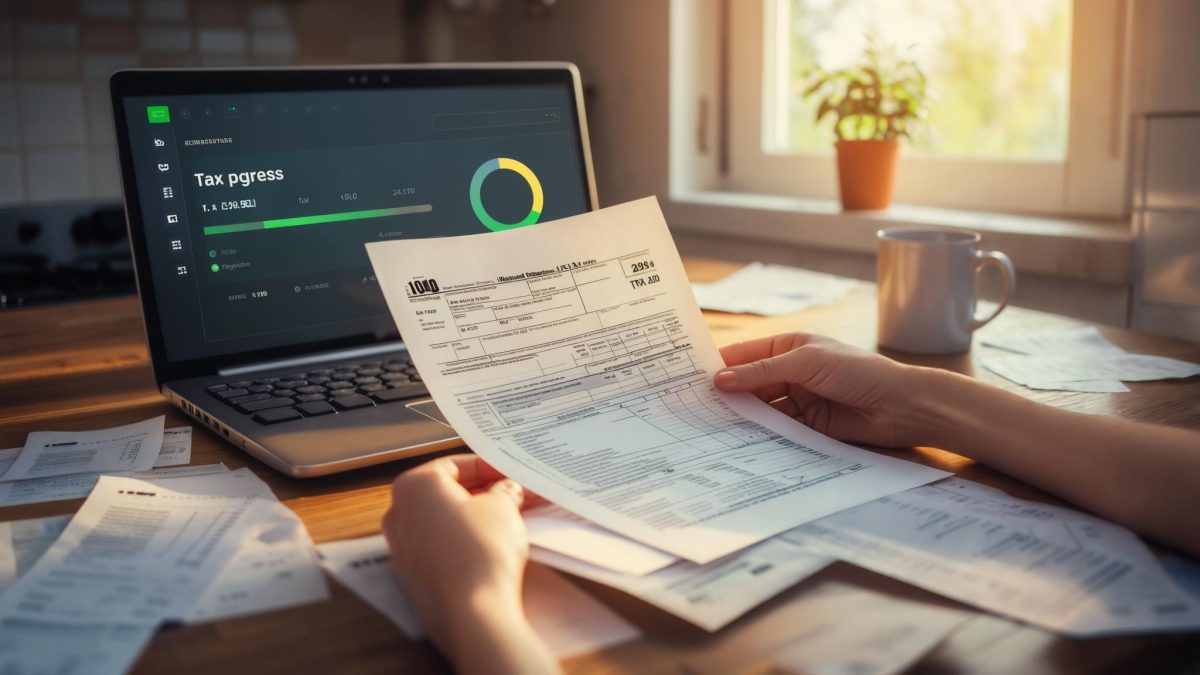
The IRS began accepting 2025 tax returns on January 27, 2026 — and by the following morning, millions of Americans had already submitted their filings. Among them was Ruben Hargrove, a 51-year-old retail store manager in Tampa, Florida, who hit send on his return at 7:14 a.m. on January 28. He remembers the exact time because he had been up since 5:30, sitting at his kitchen table while his three-year-old son, Marcus, slept in the next room.
I connected with Ruben in mid-March through a Tampa-area veterans’ support group that had heard about my reporting on IRS processing delays. A group coordinator mentioned that Ruben had brought up his refund situation at a recent meeting — not asking for help, exactly, but frustrated enough to say something out loud. That alone, she told me, was unusual for him. When I reached out, he agreed to talk, though he spent the first ten minutes of our conversation insisting his situation was “probably pretty normal.”
It wasn’t entirely. But it was common enough to matter.
A Refund Built on Necessity, Not Windfall
Ruben has managed a mid-size sporting goods retail location in the Tampa Bay area for going on nine years. His annual salary sits at roughly $52,000 before taxes — a number that sounds stable until you factor in what he’s carrying alone. His employer does not offer health insurance, so Ruben pays $487 a month for a marketplace plan that covers him and Marcus through the HealthCare.gov exchange. His ex-partner has not made a child support payment in over a year.
When I sat down with Ruben Hargrove at a Panera near his store on a Thursday afternoon, he had a folder with him — printed W-2s, a screenshot of his IRS account, and a handwritten note tallying what he had expected versus what arrived. “I don’t usually keep paper records of anything,” he said. “But this one I needed to see in front of me.”
His 2025 return was filed as Head of Household, claiming Marcus as a dependent. Based on his income and filing status, his tax software estimated a federal refund of $3,847. That figure included the $2,000 Child Tax Credit, a partial Earned Income Tax Credit of approximately $890, and withholding overpayments. He had also paid out-of-pocket for two urgent care visits for Marcus totaling $614 in late 2025 — a factor he hoped might push the number even slightly higher.
Forty-Seven Days of ‘Processing’
Ruben checked the IRS Where’s My Refund tool every day from January 29 onward. For the first three weeks, the status simply read: Return Received. That was expected — the IRS typically takes 21 days to issue most electronically filed refunds, according to the agency’s own guidance. But around day 22, the status shifted to Processing and stayed there.
“I figured something was off maybe around week four,” Ruben told me. “But I kept telling myself not to panic. I Googled it every other day. Half the articles said wait longer, half said call. I didn’t call because I didn’t want to sit on hold for two hours and find out something bad.”
That reluctance — to call, to dig, to know — is something he named without much prompting. Ruben described himself as someone who tends to project calm even when he isn’t feeling it. At work, he manages a staff of 22 people and has a reputation for steadiness. At home, with Marcus, that same instinct kicks in. “I don’t want him to grow up in a house where money stress is the background noise,” he said. “So I just carry it myself.”
By day 35, he had put a $412 co-pay for Marcus’s ear infection on a credit card — money he had been planning to pay from the refund. By day 40, that card’s balance had grown to $1,100.
The Call That Explained Everything
On March 16, 2026 — day 47 after filing — Ruben checked his bank account before leaving for work and found a deposit of $3,214. His first reaction, he told me, was relief. His second was confusion. The number was wrong.
He called the IRS at 800-829-1040 that afternoon and waited 58 minutes to reach a representative. The agent explained that $633 had been applied to an outstanding balance from his 2023 tax year — a balance Ruben said he had not known existed, or had half-known but assumed was resolved. A notice had apparently been mailed in October 2024. He believes it went to an old address during a period when he had recently moved.
The deduction was processed through the Treasury Offset Program, a federal mechanism that allows the government to intercept tax refunds to collect delinquent federal and state debts. According to the Bureau of the Fiscal Service, the program collected over $5.2 billion in federal tax debts in fiscal year 2023 alone. Filers can check whether an offset is pending on their refund by calling 800-304-3107 — a number that does not appear on most tax preparation software screens.
What the Numbers Actually Meant for Ruben’s Month
Ruben had mentally allocated his expected $3,847 before it arrived. That’s not irresponsibility — that’s what living on a tight margin looks like. When I asked him to walk me through how he had planned to use it, he did so without hesitation, which told me he had run the math many times.
- $1,100 — pay down the credit card balance he had accumulated since January
- $974 — three months of health insurance premiums paid in advance (he tends to fall behind in spring)
- $600 — childcare co-pays through Marcus’s daycare, which charges $215 per week
- $700 — emergency savings buffer, something he tries to maintain at $1,000 but had drained to $300
- $473 — remainder for any unexpected expense
The $633 offset collapsed that last category entirely and pulled from the emergency buffer column. Ruben was left having to choose between restoring savings and staying current on insurance. He chose insurance. “Marcus gets sick a lot,” he said simply. “He’s three. That’s what three-year-olds do.”
The Broader Picture: Why Refund Delays Hit Lower-Middle-Income Filers Hardest
Ruben’s situation is not rare. For lower-middle-income households — particularly those claiming the Earned Income Tax Credit or Child Tax Credit — the annual tax refund functions less like a bonus and more like a delayed paycheck correction. The IRS has noted that returns claiming the EITC are subject to additional review under the PATH Act, which historically delayed some refunds until late February even for early filers.
For the 2026 filing season, the IRS reported issuing roughly 90 percent of refunds within 21 days for electronically filed, error-free returns. That leaves a meaningful share of filers waiting longer — and unlike Ruben, not everyone knows to check their IRS online account for pending notices or outstanding balances before they file.
Where Ruben Stands Now
When I spoke with Ruben again by phone in late March, he had paid off $980 of the credit card balance and was current on Marcus’s daycare. His emergency fund sat at $420 — short of his $1,000 target but better than the $300 it had reached in February. He had also located the original 2023 IRS notice in a box of mail he had never fully sorted after moving.
“It was there,” he said. “I just didn’t open it. I think I saw the IRS return address and put it in a ‘deal with it later’ pile.” He paused. “There’s a lot in that pile.”
He does not plan to make the same mistake next year. He has already set a reminder to log into his IRS online account each December to check for any outstanding balance before he files. He also said he plans to bring it up at the veterans’ group — not as a cautionary tale, but because several other members had mentioned refund problems of their own and nobody had explained the offset system to them either.
Ruben’s outcome wasn’t a disaster. He got most of what he was owed. Marcus is healthy. The bills are largely current. But the gap between what he expected and what arrived — $633 — cost him a month of financial anxiety, a credit card balance he hadn’t planned to carry, and the quiet erosion of the emergency cushion he had spent a year rebuilding.
For a man who carries his stress alone, by design, that’s not a small thing. It’s just an invisible one.
Related: She Cosigned a Loan She Never Borrowed. Now She Owes Taxes on Debt She Never Spent.




Leave a Reply