
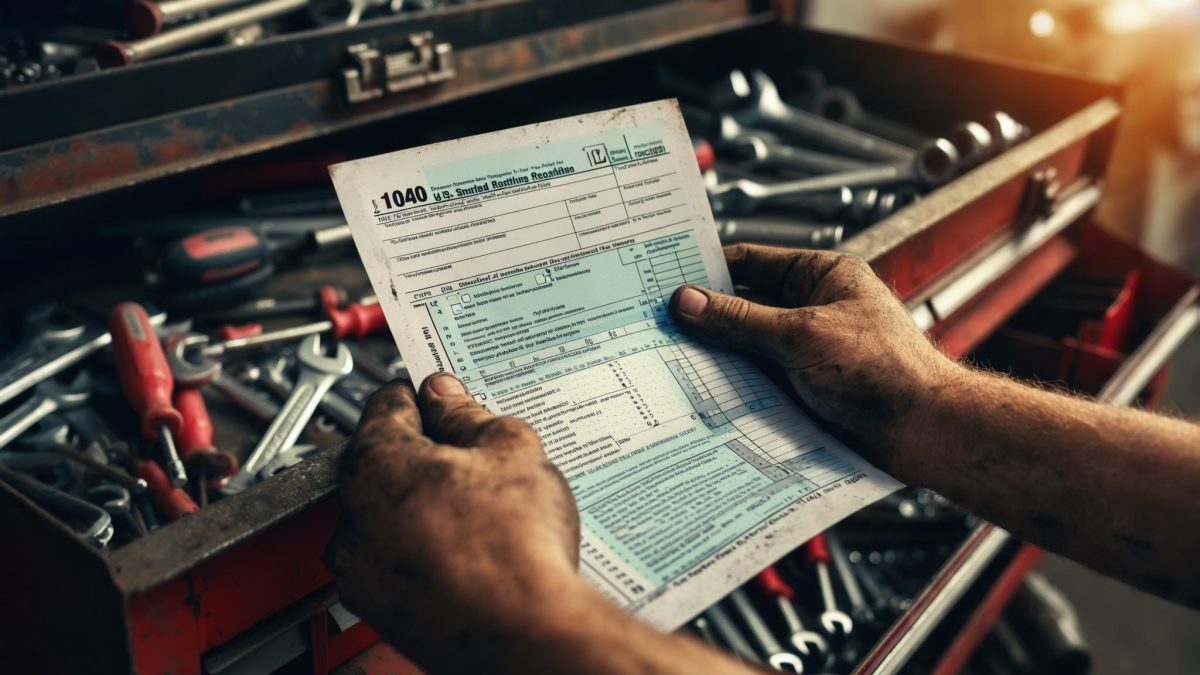
Most people assume owing the IRS money means you had a good year. That assumption is wrong, and Robert Kowalski is living proof. When I drove out to his shop on the northwest side of Milwaukee on a grey Tuesday morning, he was wiping his hands on a shop rag and already shaking his head before I’d asked a single question.
Robert Kowalski is 52 years old, has run his own auto repair business for 18 years, and has never missed a tax filing deadline. That part, he’s proud of. What he didn’t fully understand — not until this past tax season — is how the IRS treats a self-employed person whose business is slowly bleeding out.
When the Work Slows Down but the Tax Bill Doesn’t
The story Robert told me starts about three years ago, when he first noticed that newer vehicles were locking him out of diagnostic work. Modern cars increasingly require manufacturer-specific software and dealer-authorized tools to access onboard systems. For a one-bay independent shop like Robert’s, that meant watching job after job walk out the door to the dealership.
“I can still do brakes, exhaust, suspension — the mechanical stuff,” he told me. “But if someone drives in with a check engine light on a 2023 model, half the time I have to send them away. That never used to happen.”
His shop pulled in roughly $68,000 in net profit for tax year 2025 — down from closer to $97,000 three years earlier. On paper, $68K sounds manageable. But Robert files as a sole proprietor on Schedule C, which means every dollar of that profit is subject to self-employment tax at 15.3% — covering both the employee and employer sides of Social Security and Medicare. According to the IRS guidance on self-employment tax, self-employed individuals pay the full 15.3% on net earnings up to the Social Security wage base, which was $176,100 for 2025.
That alone is approximately $9,792 before a single dollar of federal income tax is added. Robert knew this, in theory. What caught him off guard was the combination of reduced estimated tax payments — he’d scaled them back when revenue dropped — and a miscalculation of his deductible business expenses.
The Quarterly Payment He Skipped
Self-employed taxpayers are generally required to make quarterly estimated tax payments using Form 1040-ES. The due dates for tax year 2025 were April 15, June 16, September 15, and January 15, 2026. Robert made the first two payments on time. Then in September, the shop’s water heater failed, he had to replace two diagnostic lifts, and he decided the Q3 payment could wait.
“I told myself I’d catch up in January,” he said, leaning against a workbench. “Then January came and I figured, I’ll just square it all up when I file. I’ve been doing this 18 years. I know how to handle the cash.”
When his tax preparer ran the numbers for the 2025 return, Robert owed $4,340 in federal taxes — plus an underpayment penalty of approximately $210 for the missed September installment. It wasn’t catastrophic. But for a man whose wife’s income is currently the household’s grocery and utility budget, it landed hard.
“My wife doesn’t say anything,” Robert told me. “She just gets real quiet. That’s worse.”
No Retirement Plan, and a Son Who Got Into College
The tax bill was only one piece of what Robert was sitting with when I met him. The other was a letter from the University of Minnesota — his 18-year-old son had been accepted. Tuition, room, board, and fees: approximately $45,000 per year.
Robert has no formal retirement savings. No SEP-IRA, no Solo 401(k), no SIMPLE plan. For 18 years, he reinvested everything back into the shop. “Financial plans are for people who have money left over,” he told me, with the flat certainty of someone who’s repeated the line enough times it no longer sounds defensive. “I never had money left over.”
What his tax preparer pointed out — and what Robert admitted he hadn’t known before — is that contributions to a SEP-IRA are deductible against Schedule C income for the same tax year, effectively reducing the self-employment tax base. For tax year 2025, the SEP-IRA contribution limit was 25% of net self-employment earnings, up to $70,000. On $68,000 in net profit, a maximum contribution would have been roughly $12,698 — and it would have meaningfully reduced both his income tax and his SE tax exposure. According to the IRS retirement plan guidelines, SEP-IRA contributions for a given tax year can be made as late as the tax filing deadline, including extensions.
He had until April 15, 2026 — or October 15 if he filed an extension — to make that contribution for 2025. He found this out on February 28th, with the clock still running.
What the Return Actually Showed
Robert’s completed 2025 federal return reflected the following, as he walked me through it:
- Gross shop revenue: approximately $112,000
- Deductible business expenses (parts, tools, utilities, insurance): roughly $44,000
- Net Schedule C profit: $68,000
- Self-employment tax: $9,792 (with a deduction of half that amount, or $4,896, against gross income)
- Adjusted gross income after SE deduction: approximately $63,104
- Standard deduction for married filing jointly (2025): $30,000
- Federal tax owed before credits: approximately $5,100
- Estimated payments made: approximately $3,200
- Balance due at filing: $1,900, plus the underpayment penalty
Robert was unaware the American Opportunity Tax Credit existed until his preparer flagged it. His son will be a first-year student in fall 2026, meaning the credit could potentially apply to tax year 2026 — if his son qualifies and Robert’s return reflects the tuition payments. That’s not a refund this year, but it was information he hadn’t had before.
Where Things Stand Now
When I asked Robert what he planned to do about the balance due, he shrugged with the particular resignation of someone who has been self-sufficient long enough that asking for help physically hurts. He had enough to pay the $1,900 plus penalty without touching the household account. His wife wouldn’t have to know the exact number.
As for his son’s tuition, Robert told me the plan was simple, if painful: his son would take out federal student loans for the first year, and Robert would figure out the rest before fall. He said it with the same tone he uses when he quotes a job estimate — certain, a little aggressive, not entirely sure he can deliver.
“I didn’t save for retirement because I was building the shop,” he told me as I was getting ready to leave. “Now the shop isn’t worth what it used to be, and I’m 52. The math doesn’t work out the way I thought it would.”
He wasn’t asking for sympathy. He was just saying it out loud, maybe for the first time.
I drove back down the highway thinking about the version of the American self-employment story that nobody tells — the one where you do everything right for almost two decades and still arrive at 52 with a declining business, a tax bill you weren’t expecting, and a kid who got into a school you can’t quite afford. Robert Kowalski isn’t a cautionary tale. He’s just a man doing the math in a world that keeps changing the numbers on him.




Leave a Reply