

Have you ever built an entire financial plan around a refund that hasn’t arrived yet — and then watched that plan quietly collapse? When I first connected with Wanda Reeves, that’s exactly where she was: sitting at a kitchen table in Oklahoma City, staring at a printed IRS “Where’s My Refund” screenshot that showed the same word it had shown for six weeks: Processing.
I met Wanda in late March 2026, entirely by accident. I was doing a ride-along with a Meals on Wheels volunteer coordinator named Deb Castillo for a separate story about food access and senior isolation in Midwestern cities. During a break between deliveries, Deb mentioned that one of her regular drivers — a nurse who worked long shifts and still showed up on her days off — was going through something with the IRS that had her rattled. Deb gave me Wanda’s number that afternoon. Wanda called back within the hour.
“I’m not someone who usually talks about money,” Wanda told me when we finally sat down together at her home a few days later. “But I’ve been so stressed about this refund that I think I need to say it out loud to someone.”
A Blended Family, a Complicated Tax Year, and a $4,200 Refund That Felt Like a Lifeline
Wanda Reeves is 46 years old, a registered nurse with over 18 years in critical care, and a woman who, by most measures, has built a stable life. She remarried four years ago, and the blended household — her two children from her first marriage, her husband Marcus’s daughter, and a teenage son they’re raising together — means the finances are always more layered than they look from the outside.
Her base nursing salary sits around $74,000 annually, but Wanda picks up extra shifts, does occasional travel nursing contracts, and ran a small medical staffing side business in 2024 that generated roughly $18,400 in 1099 income. That irregular income is both her advantage and her headache. “The overtime is great until tax season,” she said, “and then you realize you’ve been treating it like free money all year.”
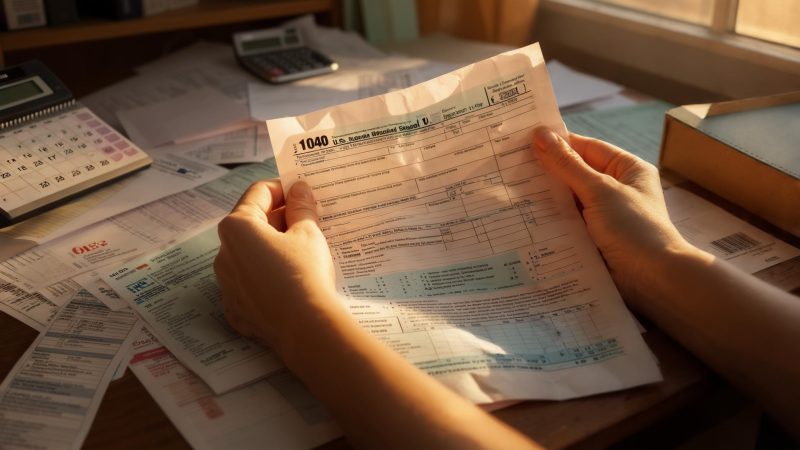
For the 2025 tax year, Wanda and her husband Marcus filed jointly on February 11, 2026. Their return included W-2 income from her hospital employer, Marcus’s W-2 from a logistics company, and Wanda’s Schedule C for the staffing side work. A tax preparer they’ve used for three years estimated their federal refund at approximately $4,200 — a number Wanda had already mentally earmarked. Oklahoma County had assessed $3,800 in back property taxes on their home, with a delinquency penalty clock ticking toward April 30.
“We were behind on the property taxes because 2024 was a weird year,” Wanda explained. “Marcus had a gap in employment for about four months, and I was covering everything. We made it work, but the property tax just kept sliding.” The refund felt like a clean solution: file early, receive by mid-March, pay off Oklahoma County by the April 30 deadline, and reset.
The IRS Letter That Changed the Timeline
The first signal that something was off came on February 28, 2026 — seventeen days after Wanda filed. The IRS Where’s My Refund tool shifted from “Return Received” to a status message indicating her return required additional review. No specific reason was given. The tool told her to wait.
Then, on March 9, a physical letter arrived: IRS Notice CP05. According to the IRS’s own explanation of the CP05 notice, it means the agency is holding a refund while it verifies income, tax withholding, or tax credits claimed on the return. The notice does not mean a taxpayer did anything wrong — it is a review process. But it also comes with no guaranteed resolution timeline. The letter Wanda received instructed her not to contact the IRS for at least 60 days.
Wanda told me she read that letter three times. “I kept looking for what I did wrong,” she said. “My preparer looked at it too and said it was probably the Schedule C that flagged it. But knowing the reason didn’t make the waiting any easier.”
The 60-day hold meant her earliest resolution date, if the review ran its full course, would land around May 9 — ten days after the Oklahoma County property tax deadline. Her carefully timed plan had a ten-day gap in it, and that gap was expensive. Late penalties from Oklahoma County assessors run approximately 1.5% per month on unpaid balances, according to county records.
What Wanda Did While She Waited — and What She Wished She’d Known
When I asked Wanda how she spent the weeks between the CP05 notice and any news from the IRS, she laughed — the kind of tired laugh that carries a month of stress in it. She did what she always does when money gets tight: she looked for more work.
She also called her tax preparer repeatedly, checked the IRS online account portal, and at one point attempted to reach a live IRS agent by phone. That call, she said, lasted 47 minutes on hold before disconnecting. The IRS has publicly acknowledged that phone wait times during peak filing season — roughly February through mid-April — can run well over an hour, with callback systems often unavailable.
What Wanda didn’t know at the time, and only learned later through her preparer, was that filers with self-employment income on a Schedule C face a statistically higher rate of CP05 holds. The IRS cross-references self-reported 1099 income against third-party filings from payers, and when those figures don’t align perfectly — even within a few hundred dollars — it can trigger a manual review. In Wanda’s case, one of her staffing clients had issued a 1099-NEC for $6,200, while Wanda had reported $6,400 from that client, citing additional reimbursements. A $200 discrepancy held up a $4,200 refund for weeks.
The Refund Arrived — But the Timing Still Stung
On April 29, 2026 — exactly 77 days after Wanda filed — the IRS deposited $4,263 into her checking account. The extra $63 was statutory interest the IRS is required to pay when a refund is delayed past 45 days from the filing deadline, per IRS interest rate guidelines. Wanda paid Oklahoma County the next morning: $3,800 in back taxes plus $57 in late penalties that had accrued during the wait.
The math still worked. But Wanda was clear-eyed about what it had cost her in other ways — the extra nursing shifts, the elevated stress, the strain of not knowing when or whether the money was coming.
Wanda told me she’s already talking to her tax preparer about adjusting her quarterly estimated tax payments for 2026 — a way of smoothing out the lump-sum refund dynamic that made this year so stressful. The staffing side business is still running, but she’s keeping closer records of every 1099 issued and reconciling them herself quarterly so there are no discrepancies at filing time.
What Wanda’s Story Reflects About IRS Processing in 2026
Wanda’s experience is not unusual. The IRS processed approximately 150 million individual returns in 2025, and a meaningful fraction of those — particularly returns with self-employment income, multiple income streams, or refundable credits like the Earned Income Tax Credit — go through extended review. The agency has publicly stated that most refunds are issued within 21 days for electronically filed returns, but that window explicitly excludes returns requiring additional review.
What struck me about Wanda’s case was how ordinary it was — and how much damage an ordinary delay can do when a family has already made plans around a specific number arriving on a specific date. She wasn’t negligent. She wasn’t trying to overclaim. She filed early, used a professional preparer, and still ended up in an 11-week hold because of a $200 discrepancy between two sets of paperwork that were both technically correct.
“The thing about working irregular hours,” Wanda told me as I was leaving her house, “is that you get really good at planning for uncertainty. Except when you think you’ve finally got something locked in — like a refund date — and then that disappears too. That’s when it hits different.”
I drove home from Oklahoma City thinking about that phrase: locked in. A refund on paper is not money in an account. Wanda knows that now in a way she didn’t on February 11. She’s already building a different kind of buffer for next year — one that doesn’t depend on an IRS timeline holding steady. That’s not a happy ending exactly. But it’s a real one.
Vivienne Marlowe Reyes is a Senior Tax & Stimulus Writer at Check Day America. She covers IRS processing timelines, refund delays, and the human cost of tax system complexity.
Related: A Nurse’s $3,200 Tax Refund Was Seized for His Spouse’s Hidden Debt — Then He Found IRS Form 8379
Related: She Retired from USPS at 33 With a Spine Condition — Then Her Health Insurance Bill Hit $612 a Month



Leave a Reply